
Article Outline
- Introduction
- The demand for custom branded towels across Australia’s retail, hospitality, and corporate sectors
- Challenges facing Australian procurement teams: Stock inventory limits vs. direct factory customization
- Pakistan’s role as a major exporter of high-durability cotton terry textiles
- Local Stock Importers vs. Direct Custom Towel Manufacturers
- Trade-offs between lead times, unit costs, brand uniqueness, and structural customization
- Core Customization Variables for Australian Businesses
- GSM Selection Matrix: Aligning fabric weight (300–700 GSM) with application (gyms, hotels, retail, beach)
- Yarn & Fiber Specifications: Single ring-spun, 20/2 double ring-spun, combed cotton, and zero-twist
- Weaving & Texture Styles: Terry pile, velour, waffle weave, flat-woven / pestemal, and double-face
- Branding & Logo Application Techniques
- Woven jacquard logos, dobby headers, relief terry weaving, precision embroidery, and screen printing
- Private Label Packaging & Compliance for Australia
- Care labelling standards (ACCC compliance), custom woven tags, barcode hangtags, and retail polybags
- Step-by-Step Bulk Procurement & Import Framework
- Developing technical spec sheets, lab dips, pre-production sampling, and ocean freight logistics to Australia
- Partnering with Noorpur Industries Pvt Ltd
- Direct factory OEM/ODM custom towel manufacturing, strict quality control, and Australian export solutions
- Conclusion & B2B Inquiry Call to Action
Full SEO Article
Custom Towel Manufacturers: A B2B Sourcing Guide for Australian Businesses
The Australian market for commercial, retail, and promotional textiles requires high product performance. E-commerce retailers, boutique hotel chains, luxury spas, fitness franchises, and promotional merchandise agencies across Australia are moving away from generic off-the-shelf inventory. Instead, they are partnering directly with custom towel manufacturers to engineer textile products built to their exact brand specifications.
Ordering custom towels allows businesses to control yarn quality, set exact fabric weights (GSM), implement custom Pantone color matching, and integrate structural woven logos. However, transitioning from a design concept to a finished bulk shipment requires a clear understanding of textile construction, customization limits, minimum order quantities (MOQs), and ocean freight logistics.
Working with primary textile mills in established manufacturing hubs like Pakistan gives Australian buyers direct control over every manufacturing variable while lowering unit costs on volume orders.
Local Stock Importers vs. Direct Custom Manufacturers
Australian procurement managers generally choose between two supply models when sourcing branded towels: purchasing pre-made blank towels from local stocking distributors for secondary embellishment, or establishing direct relationships with primary custom towel suppliers.
Local Stocking Distributors
Local suppliers offer rapid dispatch times and low order minimums. This makes them suitable for quick-turnaround promotional events or small employee gifts requiring simple surface printing or aftermarket embroidery. However, off-the-shelf blanks restrict custom color choices, size variations, and woven branding options, while incurring middleman price markups.
Direct Factory Manufacturing
Sourcing directly from primary towel manufacturers in Pakistan provides full control over the textile’s structural construction. Buyers can specify yarn twist, weave patterns, exact border dimensions, and custom dyeing methods. For regional hotel chains, retail brands, and commercial distributors, direct factory manufacturing delivers substantial cost savings per unit and long-term product consistency.
Core Customization Variables for Australian Businesses
Evaluating prospective custom towel manufacturers in Pakistan requires looking past basic soft-touch finishes to inspect the underlying material specifications.
1. Selecting the Ideal GSM (Grams per Square Metre)
GSM measures the density and weight of the towel fabric. Choosing the correct GSM balances user comfort, absorbency, and commercial laundry drying costs:
- 300–400 GSM: Lightweight, durable, and quick-drying. Suited for gym towels, promotional sweat towels, travel lines, and flat-woven pestemal beach towels.
- 400–500 GSM: Medium weight. The standard choice for commercial hotel lines, pool cabana towels, and everyday retail bath collections balancing absorbency with manageable wash cycle times.
- 500–650+ GSM: Heavyweight, plush construction. Engineered for luxury retail collections, 5-star hotel suites, and premium spa retreats where maximum plushness and water absorption are required.
2. Yarn Structure and Spinning Options
A towel’s lifespan, linting levels, and softness are determined by how its yarn is spun:
- Carded Ring-Spun Cotton: Delivers durable tensile strength and absorbent loop structure at a competitive unit price point.
- Combed Cotton: Raw cotton fibers undergo an extra combing stage to strip out short, weak fibers. The resulting long-staple yarn creates smooth, low-linting towels required by high-end retail brands.
- 20/2 Double Ring-Spun Yarn: Two individual yarns are twisted together before weaving, producing strong strands that resist loop pulling and structural breakdown under commercial laundering.
- Zero-Twist Yarns: Un-twisted cotton fibers capture air between strands, producing a plush, lightweight towel with high initial absorbency.
3. Weaving Styles and Textures
Depending on your target market, custom towel suppliers can produce varied structural finishes:
- Classic Terry Pile: Uncut loop pile offering high absorbency and traditional towel texture.
- Velour Finish: The loop pile on one side is sheared flat, creating a velvety surface for crisp printed graphics or vibrant beach towel designs.
- Waffle Weave: A three-dimensional honeycomb weave that provides high absorbency with fast drying times and a compact folded footprint.
- Flat-Woven (Turkish / Pestemal): Lightweight, tightly woven cotton fabric with fringed edges, popular for Australian summer lifestyle and beach brands.
Branding and Logo Application Techniques
When manufacturing custom branded towels, selecting the right logo application method ensures brand visibility without sacrificing fabric performance.
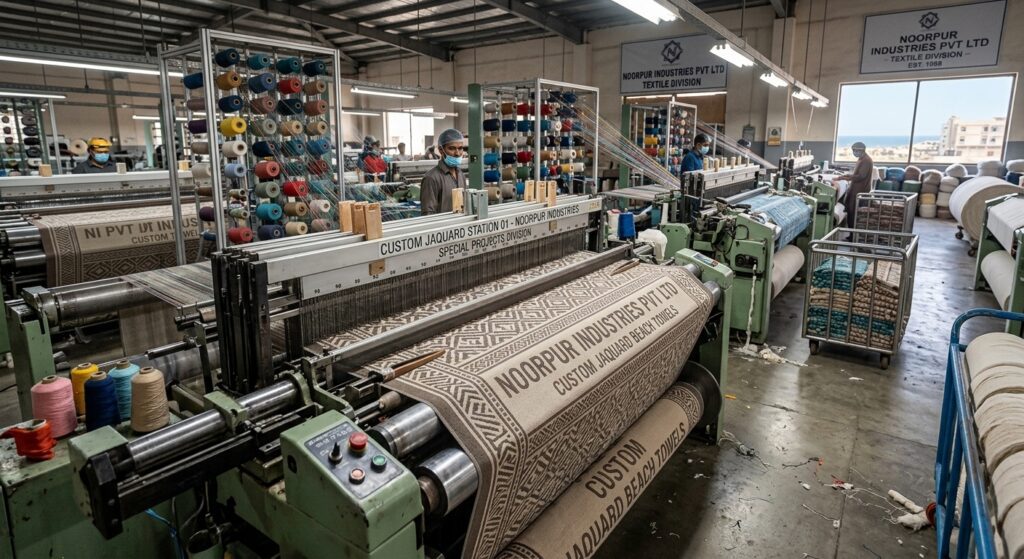
- Yarn-Dyed Jacquard Weaving: Different colored yarns are woven together to build reverse-color logos across the full towel body. This technique is widely used for resort pool towels and retail beach collections.
- Woven Dobby Headers: Logos, brand names, or custom geometric patterns are woven into the flat, non-terry border strips at the ends of the towel.
- Relief / Embossed Weaving: Created by alternating high and low loop piles to form a subtle, single-color 3D logo pattern across the towel surface.
- High-Density Embroidery: Stitched thread monograms or small logos applied along the hem edge, providing an elegant finish for boutique hotels, corporate gifts, and spa linens.
Dyeing Standards and Commercial Fastness
For Australian hospitality and commercial buyers, fabric dye fastness is critical. Commercial laundries use high wash temperatures (70°C+) alongside chlorine bleaches and heavy detergents.
- Reactive Dyeing: Provides vibrant color matching to custom Pantone (PMS) references. Ideal for retail, e-commerce, and fashion beach towel lines.
- Indanthrene (VAT) Dyeing: Essential for custom hotel towels, pool cabana lines, and salon linens. Vat dyes form deep chemical bonds within the cotton fibers, resisting fading from chlorine, direct Australian UV exposure, and commercial bleach washing.
Private Label Packaging & Australian Compliance
Custom towel manufacturing extends beyond the fabric itself to include retail-ready trims and compliant product packaging.
- ACCC Care Labelling Compliance: Textiles sold in Australia must include permanent care labels disclosing fiber content (e.g., 100% Cotton) and care instructions in English.
- Custom Trimming: Includes woven brand side tags, satin care tags, and branded paper hangtags with retail barcodes and EAN numbers.
- Floor-Ready Packaging: Individual polybagging, banded multi-packs, or custom gift boxes protect products during transit and allow for immediate warehouse distribution upon arrival.
Step-by-Step Bulk Procurement & Import Framework
Importing bulk orders from a custom towel manufacturer in Pakistan follows a structured workflow to maintain product standards and shipping timelines.
- Developing the Technical Specification Brief: Outline target dimensions, GSM, yarn specifications, dye type, header style, logo application method, and packaging requirements.
- Lab Dips and Pre-Production Sampling: The factory produces lab dips (dyed fabric swatches) for color matching and physical counter-samples for testing hand-feel, absorbency, and border stitching.
- Bulk Manufacturing and In-Line QC: Once samples are approved, production moves to automated terry looms. Quality control teams inspect weaving uniformity, weight consistency across batches, seam strength on double lock-stitched edges, and color fastness.
- Freight and CBM Optimization: Towels are compressed using hydraulic press baling (for bulk utility stock) or compressed carton packing. This maximizes container capacity (CBM), reducing ocean freight costs per unit.
- Customs Clearance and Delivery: Ocean transit from Karachi Port to major Australian container ports (Sydney, Melbourne, Brisbane, Fremantle) averages 20 to 28 days. Working with experienced towel exporters in Pakistan ensures complete shipping documentation for Australian Border Force (ABF) clearance.
Partnering with Noorpur Industries Pvt Ltd
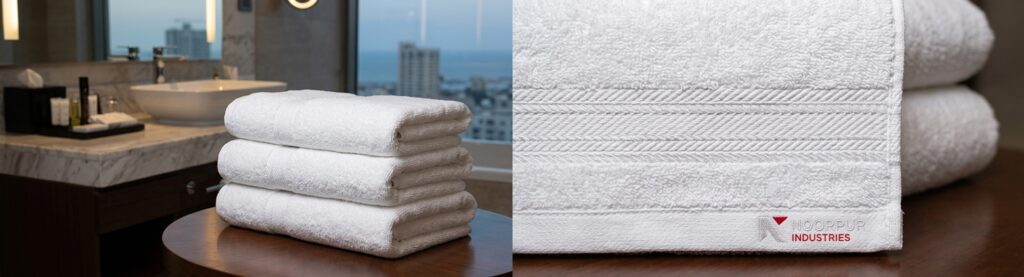
As an established towel manufacturer and exporter in Pakistan, Noorpur Industries Pvt Ltd provides contract manufacturing for Australian brands, hotel groups, distributors, and commercial buyers.
Tailored Contract Manufacturing
Noorpur Industries produces custom bath towels, hand towels, washcloths, bath mats, cabana pool towels, hooded beach towels, and utility gym towels. We build products around your weight targets, color palettes, and private label specifications.
In-House Quality Assurance
Every order undergoes multi-stage quality control. From testing raw yarn tensile strength to checking loop structure, seam integrity, and colorfastness under commercial wash conditions, our QA team ensures final shipments match approved pre-production samples.
Export Fulfillment for the Australian Market
Our export management team coordinates specification reviews, sample development, container packing optimization, and export documentation to support delivery to Australian ports.
Frequently Asked Questions (FAQs)
What is the typical Minimum Order Quantity (MOQ) for custom manufactured towels?
MOQs vary depending on order specifications, such as yarn-dyed jacquard weaving, custom Pantone dyeing, or specialized sizes. Custom factory production runs generally require higher volume commitments than purchasing standard white stock lines.
Can custom logo towels be produced with different woven borders?
Yes. We offer multiple logo integration methods, including custom woven dobby headers, two-tone yarn-dyed jacquard patterns, debossed terry relief designs, and precision border embroidery.
What yarn type is recommended for luxury retail bath towels?
Combed ring-spun cotton and zero-twist cotton yarns are recommended for retail lines. Combed cotton removes short fibers for a smooth, low-lint surface, while zero-twist yarns trap air to create a soft, highly absorbent pile.
What is the benefit of Indanthrene (VAT) dyeing for pool towels?
Vat-dyed yarns form strong chemical bonds within the cotton fibers, making the finished towels highly resistant to fading from chlorine pool chemicals, harsh Australian sunlight, and commercial laundering bleaches.
How long does it take to manufacture and import custom towels from Pakistan to Australia?
Sample development and lab dips typically take 10 to 14 days. Once samples are approved, bulk production takes approximately 30 to 45 days, followed by 20 to 28 days of ocean transit from Karachi Port to major Australian ports.
Do custom towels imported into Australia require specific care labels?
Yes. Mandatory Australian care labelling standards require permanent labels showing fiber composition (e.g., 100% Cotton) and care instructions in English.
Request Your Custom Towel Manufacturing Quote
Engineering a custom towel line requires a production partner capable of delivering consistent fabric performance, precise specification matching, and reliable export fulfillment. Whether launching a retail home textile line, outfitting a resort, or expanding a commercial supply business in Australia, Noorpur Industries Pvt Ltd provides the manufacturing capabilities to support your growth.
Ready to start your custom towel project?
Contact our export team today to submit your technical specifications, order sample swatches, or request a factory-direct wholesale quote.