
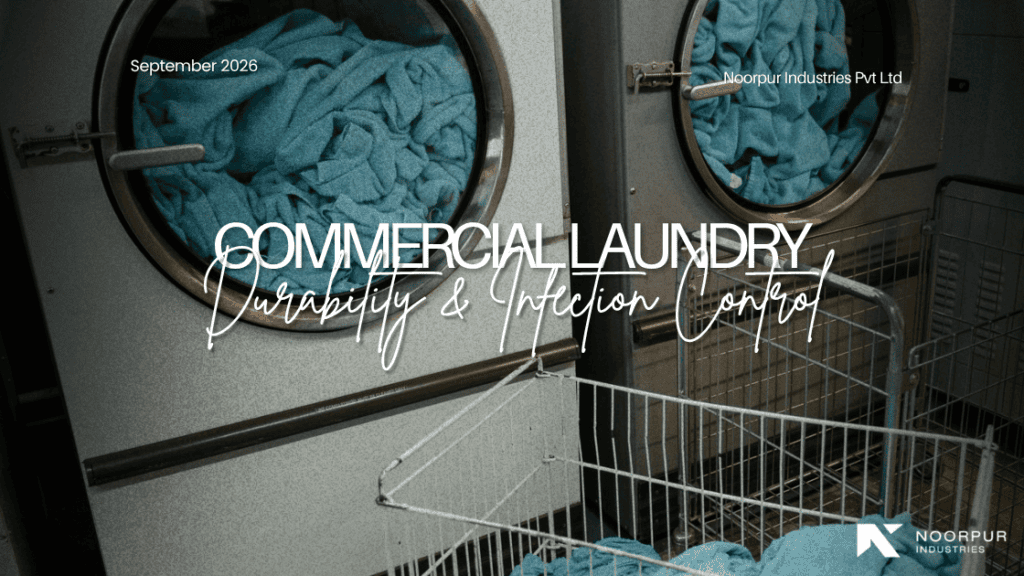
In institutional healthcare environments, private hospital networks, and aged-care facilities across Australia, the UK, and the European Union, bath towels, hand towels, and face washers are critical clinical infection control barriers. Every day, healthcare textiles are exposed to blood, bodily fluids, harsh chemical disinfectants, and heavy biological soil loads. To maintain hygiene, these linens undergo aggressive industrial wash formulas – combining thermal disinfection temperatures ($65^\circ\text{C}$ to $90^\circ\text{C}$), high-alkalinity detergent bath cycles, mechanical hydraulic pressing, and continuous high-heat tumble drying.
For healthcare procurement directors, hospital supply chain leads, and commercial laundry operators, sourcing standard domestic or consumer-grade towels leads to rapid fiber degradation, tensile strength loss, fraying side hems, shrinkage, and failure during infection control audits. Healthcare towels must be structurally engineered to satisfy strict regional infection control mandates – such as AS/NZS 4146:2000 (Laundry Practice) in Australia and EN 14065 (RABC Framework) in Europe – while preserving absorbency and softness across hundreds of wash cycles.
This comprehensive technical B2B guide breaks down the infection control standards governing healthcare linens, analyzes the structural textile engineering required for high-temperature thermal disinfection, evaluates total cost of ownership (TCO) dynamics, and details how Noorpur Industries Pvt Ltd manufactures export-grade institutional textiles for Australian and European healthcare suppliers.
Regulatory Frameworks: AS/NZS 4146:2000 & EN 14065 (RABC)
Healthcare textiles entering hospital networks in Australia or Europe must strictly comply with regional laundry infection control standards.
1. Australian Standard AS/NZS 4146:2000 (Laundry Practice)
In Australia and New Zealand, hospital and aged-care laundries operate under AS/NZS 4146:2000. To achieve certified thermal disinfection without chemical additives, soiled linens must be held at specific minimum temperature thresholds during the wash cycle:
- Option A: $\ge 65^\circ\text{C}$ held continuously for at least 10 minutes.
- Option B: $\ge 71^\circ\text{C}$ held continuously for at least 3 minutes.
Towels must withstand these elevated temperatures along with high-alkalinity wash liquors ($\text{pH } 10.5 – 11.5$) and oxygen/chlorine bleaching agents without suffering severe fiber breakdown or dimensional warp/weft shrinkage.
2. European Standard EN 14065 / HTM 01-04 (RABC System)
Across the European Union and the United Kingdom (governed by HTM 01-04 in NHS facilities), laundry processors utilize the Risk Analysis and Biocontamination Control (RABC) framework under EN 14065. RABC ensures continuous microbiological quality control across the entire processing chain – from dirty sorting and wash-formula disinfection to clean drying, folding, and transport.
For detailed technical analysis on dye stability under high-temperature chemical wash environments, review our guide on VAT-Dyed vs. Reactive-Dyed Commercial Towels.
Structural Textile Engineering for Healthcare Durability
Standard retail towels rely on soft, low-twist yarns and decorative dobby borders that shrink, bow, or tear when subjected to commercial tunnel washers and high-pressure hydraulic extraction presses. Healthcare towels require specialized construction parameters to maintain structural integrity.
1. High Tensile Ground Warp Construction
The primary cause of towel destruction in commercial laundries is tearing along the ground fabric during high-speed centrifugal extraction or hydraulic pressing. By using 20/2 plied ring-spun ground warp yarns, the fabric’s tensile strength is doubled compared to single-yarn domestic towels, preventing longitudinal splitting.
2. Camless (Border-Free) Design
Traditional woven dobby headers or decorative borders contain different yarn tension profiles than the terry pile body. When exposed to $71^\circ\text{C}$ wash temperatures, the border shrinks at a faster rate than the loops, creating “hourglass” bowing and structural distortion. Healthcare towels feature camless (plain hemmed or continuous loop) constructions to eliminate differential shrinkage entirely.
3. Double-Needle Lock-Tacked Edge Hems
Commercial laundries utilize high-velocity air-jet automatic folders. Weak side hems fray and unravel rapidly under these conditions. Institutional towels are stitched using double-needle parallel lockstitching with heavy polyester-core threads and reinforced bar-tacking at all four corners.
To learn more about mass density options and loop pile height balancing, explore our technical guide on How GSM Affects Towel Quality.
Thermal Disinfection vs. Chemical Degradation: The Material Science
During industrial laundering, healthcare textiles undergo repeated chemical oxidation to remove stubborn biological stains and eliminate viral/bacterial pathogens.
Degree of Polymerization (DP) & Fiber Longevity
Raw cotton cellulose possesses a high Degree of Polymerization (DP $\approx 2,000 – 2,400$), representing the length of the molecular polymer chains. Repeated exposure to harsh chlorine bleach and high temperatures breaks these polymer chains down:
- When the DP value drops below 1,200, the cotton fibers become brittle and lose tensile strength.
- When the DP value falls below 800, the fabric tears under minimal mechanical stress.
Noorpur’s Solution: By utilizing long-staple Indus Valley cotton with high initial DP values, combined with low-friction combed spinning, our institutional towels maintain structural integrity even after 150+ high-temperature laundry cycles.
For detailed yarn specifications and fiber comparisons, see our B2B guide on Cotton Towel B2B Sourcing.
Total Cost of Ownership (TCO) Analysis for Hospital Networks
While low-cost retail or open-end towels carry a lower initial purchase price, their rapid failure rate in commercial laundries leads to high annual replacement costs.
Financial Impact Metrics:
- Lower Cost Per Wash Cycle: Sourcing structurally reinforced towels reduces the cost-per-use metric from $0.08 per wash down to $0.03 per wash.
- Reduced Discard Rates: Hospital laundries track linen replacement rates. Reinforced hems and high-DP yarns keep rag-out/discard rates under $2\%$ annually.
Technical Specifications: Standard Healthcare Linen Range
The following table outlines technical specifications for Noorpur’s primary institutional healthcare linen range:
For custom private-label branding, color-coded edging, or property-mark weaving across healthcare ranges, review our guide to Private Label Towel Manufacturers.
Manufacturing Compliance & Quality Assurance at Noorpur Industries
Producing institutional healthcare textiles requires complete oversight across raw material selection, weaving, wet processing, and quality control. Operating in Karachi, Pakistan, Noorpur Industries Pvt Ltd manufactures export-grade institutional textiles engineered for global healthcare standards.
1. In-House Laboratory Tensile & Absorbency Testing
Every production batch undergoes strict laboratory testing before export:
- Tensile Strength (ASTM D5034 Grab Test): Verifies warp and weft breaking strength before and after simulated thermal wash cycles.
- Absorbency Rate (AATCC 79): Ensures instant water sinkage ($< 2\text{ seconds}$) without using temporary chemical softeners.
- Dimensional Stability (ISO 6330): Guarantees fabric shrinkage remains under $4\%$ under industrial laundering conditions.
2. Environmental & Toxicological Safety
All healthcare textiles manufactured by Noorpur comply with OEKO-TEX® Standard 100 and EU REACH regulations, ensuring that linens entering sensitive pediatric, geriatric, or surgical hospital environments are entirely free from harmful chemicals, heavy metals, or toxic residues.
Learn more about chemical safety compliance and environmental certificates in our technical guide on OEKO-TEX & GOTS Certified Towel Manufacturers in Pakistan.
Global Sourcing Analysis: Pakistan vs. Competitor Nations
When Australian and European healthcare procurement officers evaluate global supply hubs, product quality must be balanced with trade preferences, cotton access, and landed costs.
Pakistan offers a distinct trade advantage for Australian and European buyers: combining native long-staple Indus Valley cotton with favorable trade agreements – including 0% GSP+ tariffs in the EU and DCTS duty-free access in the UK. This enables healthcare suppliers to source high-grade institutional towels at lower landed costs.
Read our complete trade analysis in Pakistan vs Other Countries for Towel Manufacturing.
Procurement Checklist: Ordering Healthcare Towels from Pakistan
Use this technical checklist during the RFQ phase to ensure bulk healthcare towel orders meet institutional laundry standards:
- Specify Camless (Border-Free) Construction: Eliminate dobby headers to prevent differential shrinking and bow distortion during $71^\circ\text{C}$ wash cycles.
- Define Hemming Standards: Require double-needle parallel lockstitching with polyester-core threads and bar-tacked corners.
- Mandate Plied Ground Warp Yarns: Specify 20/2 or 24/2 ring-spun ground warps to ensure high tensile strength under hydraulic extraction presses.
- Require Third-Party Lab Verification: Request pre-shipment lab reports confirming AS/NZS 4146 compliance, shrinkage limits ($< 4\%$), and OEKO-TEX certification.
For step-by-step guidance on shipping options, import duties, and transit logistics, review our technical guide on How to Import Towels from Pakistan to Australia.
Source High-Durability Healthcare Linens with Noorpur Industries
Selecting the right textile construction ensures long-term operational durability and strict infection control compliance. Noorpur Industries Pvt Ltd supplies hospital networks, aged-care facilities, and commercial linen hire operations across Australia, Europe, and the UK with high-performance institutional textiles.
Whether you require bleach-safe hospital bath towels, camless patient hand towels, or heavy-duty thermal blankets, Noorpur’s engineering team provides end-to-end support—from yarn selection to international delivery.
Partnering with Noorpur Industries Delivers:
- Over 50 years of specialized textile manufacturing expertise in Karachi, Pakistan.
- Direct access to 100% long-staple Indus Valley combed cotton.
- Full compliance with AS/NZS 4146, EN 14065 (RABC), and OEKO-TEX® Standard 100.
- Custom property marking, color-coded edge stitching, and institutional packing options.
- Duty-free export access to the European Union, United Kingdom, and Australia.
Contact our commercial export department today to request lab dips, physical sample swatches, or a comprehensive quotation for your next bulk order:
- Official Website: https://noorpur.com.pk
- Commercial Inquiries & Quotations: Contact Noorpur Industries Export Team