
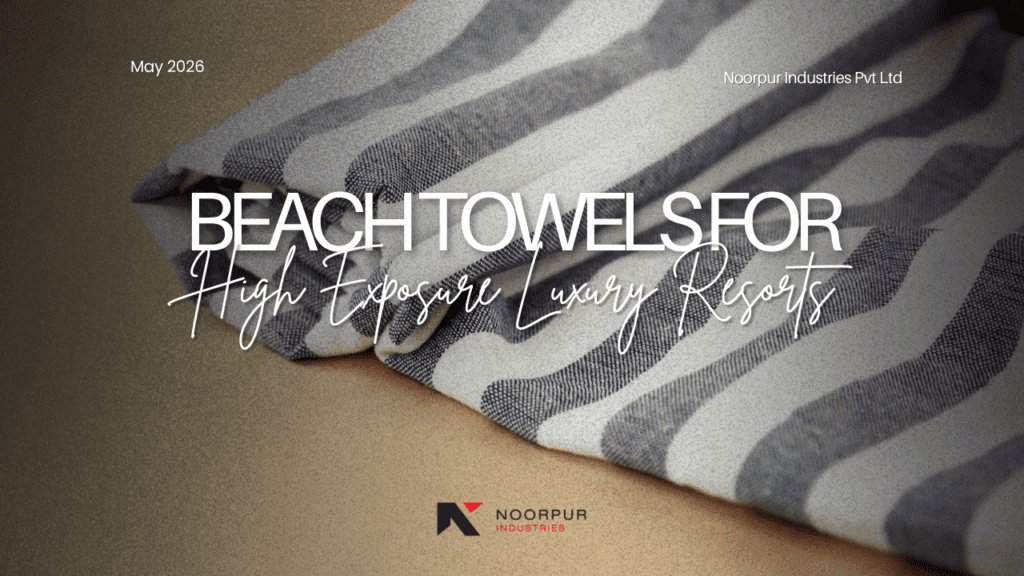
The pool decks, coastal cabanas, and open-air thermal spas across Southern Europe and Australia represent some of the most demanding operational environments in the premium hospitality industry. From the high-salinity beachfront properties of Queensland to the luxury boutique beach clubs of the French Riviera, the humble resort towel is a vital touchpoint for the guest experience. It is also an asset that directly impacts a property’s bottom line.
For corporate procurement directors and estate housekeepers, managing an outdoor linen pool is an ongoing battle against fabric degradation. Unlike standard white indoor bath linens, outdoor beach and pool towels are continuously exposed to a damaging mix of high-intensity solar ultraviolet (UV) radiation, atmospheric sea salt, body oils, cosmetic sunscreens, and highly concentrated pool chlorine.
When properties rely on generic, mass-produced retail towels or lower-grade promotional textiles, these environmental factors quickly ruin the product. Within a few dozen usage and industrial wash cycles, cheap towels suffer from patchy fading, fiber thinning, structural shrinkage, and a rough surface texture.
To maintain a flawless guest presentation, protect operational budgets, and meet strict international sustainability metrics, leading international resort networks are moving away from traditional stock trading brokers. The industry is shifting toward a highly technical solution: establishing direct-factory partnerships with premium manufacturers specializing in sustainable B2B cotton manufacturing and advanced chemical dye lock engineering.
Technical Risk Management: Stock Broker Procurement vs. Direct Factory Integration
For multi-property financial controllers, textile acquisition is fundamentally a risk-management task. Every independent trading agent or unverified middleman added to a supply chain introduces variable costs, unverified manufacturing origins, and a significant risk of quality variations between batches.
The table below outlines the operational differences between standard broker sourcing and direct factory integration:
Operating within a vertically integrated ecosystem ensures that quality control begins at the fiber level. By managing the production journey from raw cotton selection to the final double-lock stitched hem, a dedicated manufacturing partner removes quality variations, ensuring that every batch delivered to European and Australian properties performs reliably under heavy commercial use.
The Molecular Lock: Why Indanthrene Vat Dyeing Prevents Chemical Bleaching
Outdoor resort and cabana textiles face an aggressive physical lifecycle that indoor bath linens never encounter. The primary threat to a towel’s appearance is chemical oxidation caused by pool sanitizers mixed with intense solar radiation.
The Failure of Reactive Surface Dyes
Standard retail-grade towels frequently rely on basic reactive dyeing processes to minimize upfront production costs. Reactive dyes form a loose bond on the outer surface of the cotton strands.
When these textiles are exposed to high UV levels and pool chemicals, a rapid chemical oxidation process occurs. This molecular breakdown results in immediate color fading, patchy white spots, and accelerated fabric thinning, making the towels look worn and unpresentable within a single season.
The Indanthrene Vat Dyeing Standard
High-performance outdoor linens resolve this vulnerability by implementing Indanthrene vat dyeing. Indanthrene dyes are water-insoluble chemical compounds that are forced deep inside the intra-cellular core of the long-staple cotton cellulose fibers during the manufacturing process.
Instead of wrapping around the yarn, the dye molecules form a permanent molecular lock inside the fiber. This advanced chemical execution delivers essential operational protections:
Structural Engineering: Yarn Selection and Loop Geometry
Beyond color fastness, the physical endurance of a commercial resort towel is determined by the material science of its yarn and the configuration of its loop architecture. To withstand the aggressive rotation of high-volume hospitality operations, a towel must be engineered for maximum tensile strength.
Combed Ring-Spun Yarns
Low-cost institutional textiles are typically woven from carded open-end yarns, which retain a high percentage of short, weak, and immature cotton fiber fragments. Under the mechanical friction of industrial washers and the high heat of tumble dryers, these short strands quickly break free, resulting in accelerating fabric weight loss, rough surface textures, and heavy lint buildup.
Premium resort towels use 100% long-staple combed cotton processed through traditional ring-spinning frames. The combing stage pulls out all weak fiber fragments, leaving only long, resilient cotton strands. Continuous twisting locks these long fiber ends deep within the core of the yarn, creating a smooth, compact thread with superior natural tensile strength and remarkable elasticity.
Double-Loop Terry Architecture
Standard consumer towels utilize a single-loop construction that easily catches, snags, and flattens under mechanical pressure, turning the fabric slick and non-absorbent. Institutional resort textiles implement an advanced double-loop terry framework.
By twisting two high-quality ring-spun yarns together to form each upright loop, the effective surface area of the fabric is instantly doubled. These vertical double-loops remain springy through hundreds of wash cycles, creating an immediate capillary effect that absorbs water instantly on contact.
Asset Economics: Lowering the Total Cost of Ownership (TCO)
For corporate financial officers managing international procurement across large hospitality networks, textile acquisition must be evaluated through a rigorous Total Cost of Ownership (TCO) framework rather than checking initial unit prices. Sourcing low-cost, lower-grade towels might look attractive on a quarterly purchase order, but their rapid degradation creates a continuous financial drain.
Low-grade carded towels typically show severe structural breakdown – such as thinning centers, loose threads, and frayed corners – after just 70 to 90 industrial wash cycles, requiring a complete pool replacement multiple times a year.
In contrast, an engineered institutional towel constructed from combed ring-spun cotton comfortably maintains its structural integrity and plush loft for 180 to 220+ high-velocity wash cycles. By more than doubling the active lifespan of the textile asset, a property cuts its annual replacement costs in half, allowing procurement teams to fully amortize their initial investment and unlock major capital savings.
Furthermore, by moving away from trading brokers to establish direct partnerships with vertically integrated manufacturing networks, enterprise buyers eliminate hidden intermediary markups. Direct-from-manufacturer sourcing gives European and Australian hotel groups direct access to factory pricing, custom weight profiles, and consistent production quality, providing complete transparency over the global supply chain.
Global Compliance: Meeting Strict European and Australian Sustainability Mandates
As international trade regulations tighten, eco-responsible processing has evolved from a voluntary corporate social responsibility initiative into a strict legal framework. Sourcing directors across Europe are navigating the phased rollout of the EU Green Deal’s Strategy for Sustainable and Circular Textiles and the upcoming Digital Product Passport (DPP). Concurrently, Australian enterprises are managing rigorous ESG disclosures and modern slavery reporting mandates.
True sustainability must be woven directly into the manufacturing process. This requires partnering with producers utilizing closed-loop chemical systems and advanced Effluent Treatment Plants (ETP) that isolate, purify, and recycle processing water directly within the factory walls, preventing harmful chemical runoff from entering local ecosystems.
Furthermore, textiles must achieve the OEKO-TEX Standard 100 certification baseline. This international verification guarantees that every component of the linen – from the primary terry loops to the structural sewing threads and custom dyed borders – is completely free from harmful levels of toxic substances, heavy metals, or volatile organic compounds (VOCs).
In upscale hospitality environments where beach and pool towels come into direct, prolonged contact with moisture-exposed skin under intense solar heat, chemical purity is a non-negotiable health, safety, and brand metric.
Partner with Noorpur Industries Pvt Ltd
At Noorpur Industries Pvt Ltd, we combine over a decade of advanced textile engineering expertise with a deep commitment to high-performance manufacturing and international sustainability standards. Our vertically integrated production facilities specialize in crafting premium institutional linens and custom cabana beach towels engineered explicitly to withstand the rigorous operational demands of the European and Australian hospitality, healthcare, and commercial distribution sectors.
Protect your property’s operational budget, eliminate supply chain intermediaries, and secure absolute consistency across your global supply chain by contacting our corporate procurement team today.
- Corporate Head Office & Manufacturing Facility: Plot No. 78, Sector 24, Korangi Industrial Area, Karachi-74900, Pakistan.
- Direct Corporate Line: +92 345 2596100 | +92 321 2714524
- Official Corporate Email: noorpur@noorpur.com.pk
- Web Infrastructure: www.noorpur.com.pk