
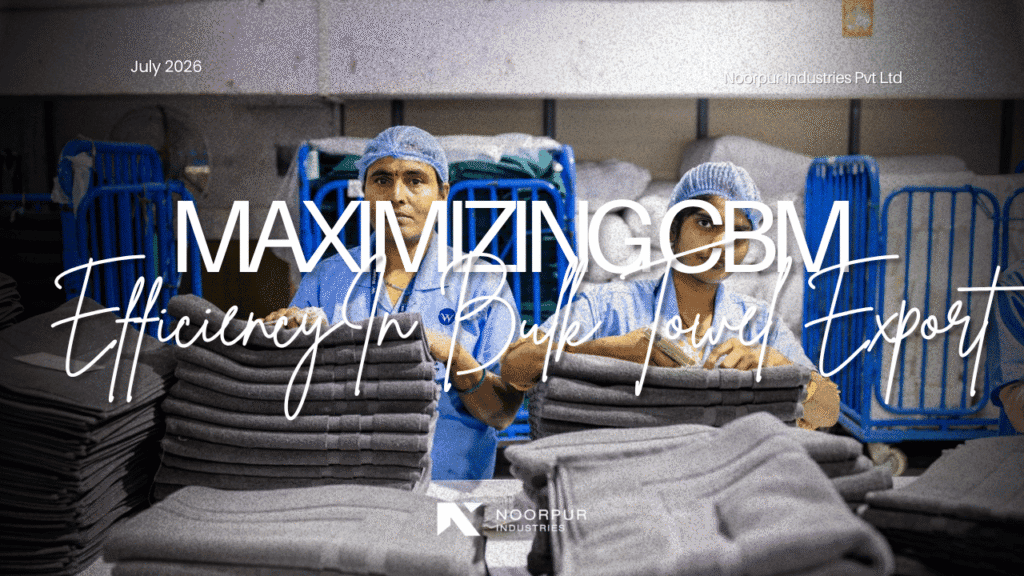
In international textile trade, ocean freight charges are governed by the relationship between cargo volume and weight. Cotton terry towels, by their structural nature, consist of high-loft loop pile designed for absorbency and softness. While this density delivers luxury to hotel guests and retail consumers, it poses a logistical challenge: standard boxed towels trap massive volumes of air, causing containers to “cube out” long before reaching their maximum allowable weight payload.
When exporting terry toweling from manufacturing hubs like Pakistan to key markets across Europe and Australia, shipping uncompressed cargo leads to inflated freight costs per unit. To maintain competitive margins, exporters must implement advanced strategies focused on cbm efficiency towel baling compression.
At Noorpur Industries Pvt Ltd, we combine automated textile manufacturing with heavy-duty hydraulic pressing and specialized compression packaging. This guide details the engineering, packaging methodologies, and mathematical principles required to optimize Container Load Factor (CLF) and lower landed costs across global trade lanes.
The Volumetric Freight Equation: Why Towels Need Compression
Ocean liners calculate freight rates for Full Container Load (FCL) shipments based on container capacity, whereas Less than Container Load (LCL) shipments utilize Weight or Measurement (W/M) pricing (1 CBM = 1,000 kg).
Because cotton terry fabric has a low uncompressed density—typically ranging between $80\text{ kg/m}^3$ and $120\text{ kg/m}^3$ when placed loosely in corrugated cartons—a standard 40-foot High Cube (40HQ) shipping container with $76\text{ m}^3$ (CBM) of internal volume reaches its volumetric limit with only $6,500\text{ kg}$ to $8,000\text{ kg}$ of uncompressed towels. This leaves up to 70% of the container’s maximum allowable weight payload ($26,000\text{ kg} – 28,000\text{ kg}$) unused.
Density Progression (kg per CBM):
[ Uncompressed Cartons: 80 - 120 kg/m³ ]  -> Low Loading Efficiency
[ Vacuum Polybags: 180 - 240 kg/m³ ]     -> Moderate Efficiency
[ Hydraulic Baled Cargo: 350 - 450 kg/m³ ] -> Maximum Container Utilization
By applying high-pressure hydraulic baling, exporters increase cargo density to $350\text{ kg/m}^3 – 450\text{ kg/m}^3$. This shift aligns volumetric utilization with weight limits, nearly doubling or tripling the physical tonnage stowed inside a single ocean vessel container.
Technical Comparison: Baling vs. Vacuum Packaging vs. Standard Cartons
Choosing the right packaging configuration requires balancing freight savings against destination hand-off requirements.
| Packaging Method | Average Density | 40HQ Payload (Weight) | Usable CBM Occupied | Primary Export Use Case |
| Standard Master Cartons | $100\text{ kg/m}^3$ | $6,800 – 7,500\text{ kg}$ | $68 – 72\text{ CBM}$ | Premium retail-ready shelf displays |
| Vacuum-Sealed Polybags in Cartons | $220\text{ kg/m}^3$ | $14,000 – 16,000\text{ kg}$ | $65 – 70\text{ CBM}$ | E-commerce fulfillment & bulk retail |
| High-Density Hydraulic Bales | $380\text{ kg/m}^3$ | $24,000 – 26,000\text{ kg}$ | $62 – 68\text{ CBM}$ | Commercial healthcare & hotel supply |
1. High-Density Hydraulic Baling
High-density baling employs industrial press units that exert between 30 to 100 tons of hydraulic pressure on folded towel stacks. The compressed block is wrapped in heavy-duty woven polypropylene (PP) fabric and secured with high-tensile steel wire or polyester strapping.
- Pros: Highest possible CBM efficiency; eliminates carton costs; protects against external moisture during long sea transits.
- Cons: Requires industrial bale-breakers at destination; causes temporary pile flattening (restored after commercial laundering).
2. Vacuum-Sealed Compression Polybagging
Individual towels or multi-packs are inserted into high-barrier poly-bags where pneumatic suction evacuates ambient air before heat-sealing. These bags are subsequently packed into outer master cartons.
- Pros: Maintains retail presentation aesthetics; protects goods from dirt; allows carton stacking at distribution centers.
- Cons: Higher unit packaging material cost; modest density increase compared to hydraulic baling.
Container Stacking & Palletization Logic
Maximizing CBM utilization requires precise container loading plans (stowage diagrams). Standard shipping containers feature specific internal dimensions:
- 20ft Dry Container: $5.90\text{m} \times 2.35\text{m} \times 2.39\text{m}$ | Usable Volume: $\sim 28 – 30\text{ CBM}$
- 40ft High Cube (40HQ): $12.03\text{m} \times 2.35\text{m} \times 2.69\text{m}$ | Usable Volume: $\sim 68 – 72\text{ CBM}$
Eliminating Dead Space (The Tetris Rule)
To achieve optimal loading efficiency, bale dimensions are engineered to match container internal width and door clearance:
- Custom Bale Sizing: Engineering bale sizes (e.g., $1100\text{mm} \times 750\text{mm} \times 600\text{mm}$) ensures two bales sit side-by-side along the $2.35\text{m}$ container width with minimal side-clearance gap.
- Interlocking Tier Stacking: Stacking bales in alternating longitudinal and crosswise layers creates structural stability without sacrificing overhead height.
- Floor-Loading vs. Palletization: While palletizing speeds up forklift unloading in European and Australian ports, standard pallets ($1200\text{mm} \times 1000\text{mm}$) consume up to 12% of total container volume in pallet clearance and vertical void space. Floor-loading compressed bales yields maximum CBM efficiency.
Cost-Benefit Analysis: Landed Cost Impact on EU and AU Routes
To illustrate the economic advantage of cbm efficiency towel baling compression, consider a commercial contract for 20,000 kg of 500 GSM bath towels exported from Karachi, Pakistan to Hamburg, Germany or Sydney, Australia.
Scenario A: Uncompressed Master Cartons (FCL 40HQ Containers)
- Required Containers: 3 x 40HQ Containers (due to volume ceiling of $\sim 6,800\text{ kg}$ per container)
- Ocean Freight Costs ($4,200 USD / 40HQ): $\$12,600\text{ USD}$
- Packaging Materials (Cartons + Tape): $\$2,400\text{ USD}$
- Total Freight & Packaging Investment: $\$15,000\text{ USD}$ ($\$0.75\text{ USD}$ per kg)
Scenario B: High-Density Hydraulic Baled (FCL 40HQ Containers)
- Required Containers: 1 x 40HQ Container (payload capacity reaching $\sim 20,000\text{ kg}$)
- Ocean Freight Costs ($4,200 USD / 40HQ): $\$4,200\text{ USD}$
- Packaging Materials (PP Woven Fabric + Steel Strapping): $\$800\text{ USD}$
- Total Freight & Packaging Investment: $\$5,000\text{ USD}$ ($\$0.25\text{ USD}$ per kg)
Net Supply Chain Savings: Baling reduces total transport expenditure by $\$10,000\text{ USD}$ (66.6% cost reduction) on a single 20-ton order, significantly lowering the final landed cost per unit.
Preserving Towel Quality During High-Pressure Baling
A common concern among procurement heads in Europe and Australia is whether intense hydraulic compression damages terry loops or distorts border trims (such as dobby or jacquard weaves).
When executed with proper manufacturing controls, high-density baling does not harm natural cotton fibers:
- Moisture Management: Towels must be baled at an optimal moisture regain level of $6.5\% – 8.5\%$. Baling wet fabric leads to mildew, whereas baling overly dry cotton creates brittle fibers.
- Elastic Recovery of Cotton: High-grade long-staple cotton fibers possess natural elasticity. Once removed from the bale and exposed to humidity or initial commercial laundering, the pile loops uncoil and return to full GSM loft.
- Reinforced Edge Hemming: At Noorpur Industries, export towels feature double-needle lockstitched side hems and reinforced header borders engineered to withstand lateral tension during hydraulic press cycles.
Why Choose Noorpur Industries Pvt Ltd?
As a premier Pakistani textile manufacturer, Noorpur Industries Pvt Ltd bridges high-capacity production with advanced logistics optimization:
- In-House Compression Infrastructure: Modern hydraulic baling presses capable of generating variable density ratings tailored to client specifications.
- Custom Logistics Engineering: Tailored packaging solutions (bales, vacuum cartons, or hybrid pack-types) calculated to maximize CBM utilization for European and Australian ports.
- Compliance & Quality Certifications: Fully certified export operations satisfying OEKO-TEX Standard 100, ISO 9001, and Australian/European trade standards.
- End-to-End Export Management: Direct coordination with major global shipping lines to ensure smooth ocean transit from Karachi (PKBQM/PKKHI) to global ports.
Frequently Asked Questions (FAQs)
What does CBM mean in shipping, and how is it calculated for towels?
CBM stands for Cubic Meter, the international standard metric for cargo volume. It is calculated by multiplying length, width, and height in meters ($\text{L} \times \text{W} \times \text{H}$). For towels, total CBM determines how many units fit into an ocean container before hitting volume capacity.
Does hydraulic compression damage the towel’s plushness or loop pile?
No. High-quality cotton fibers feature strong natural resilience. While compressed bales temporarily flatten the pile, the loops recover their original loft, absorbency, and soft hand-feel after unbaling and standard washing.
How many kilograms of baled towels can fit inside a 40-foot High Cube (40HQ) container?
With high-density hydraulic baling ($380 – 450\text{ kg/m}^3$), a 40HQ container can carry between $24,000\text{ kg}$ and $26,000\text{ kg}$ of towels, approaching the legal highway and ocean weight payload limits.
Which packaging option is better for retail stores: baling or vacuum cartoning?
For retail-ready products where individual packaging appearance is critical, vacuum-sealed polybagging inside master cartons is recommended. For institutional buyers (hotels, hospitals, laundries) purchasing in bulk, hydraulic baling provides maximum freight savings.
How do compressed bales protect textiles against sea moisture during transit?
Export bales are wrapped in heavy-duty, water-resistant woven polypropylene (PP) outer sheeting and sealed with internal polyethylene liners. This dual-layer barrier protects textiles against humidity, salt air, and dust during ocean voyages.