
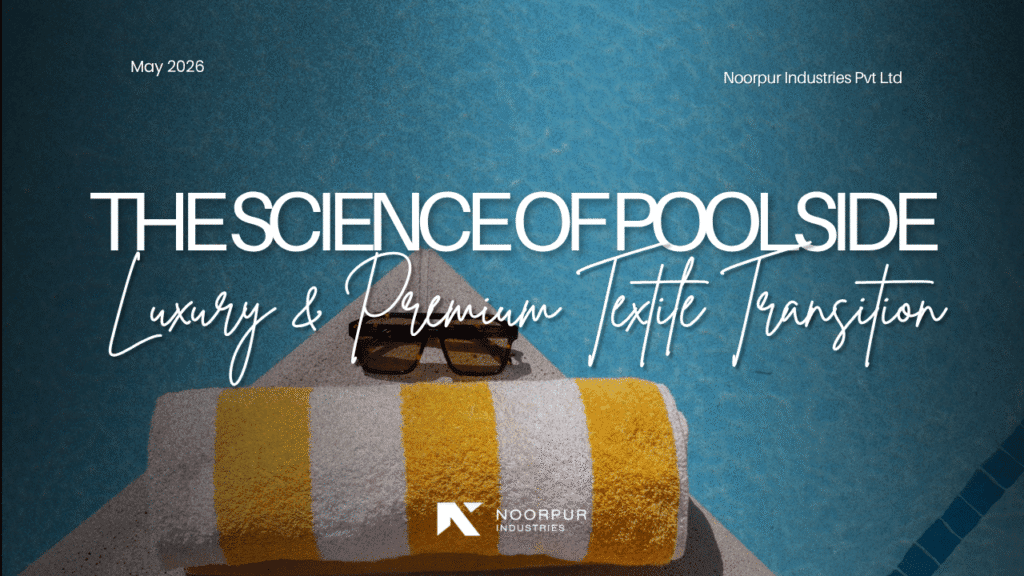
The premium leisure hospitality landscape – stretching from the sun-drenched, high-exposure beach clubs of Australia’s Gold Coast and Sydney harbor districts to the exclusive summer resorts of the European Mediterranean – is defined by its outdoor touchpoints. While the indoor guest experience is built around architectural geometry and quiet comfort, the outdoor resort environment demands a different operational mindset. In these open-air settings, the brand’s primary tactile touchpoint is the luxury resort beach towel.
For estate managers, housekeepers, and procurement directors supervising multi-property luxury networks across Europe and Australia, outdoor textile management represents a constant operational challenge. A luxury beach or pool towel faces a harsh environmental lifecycle: continuous high-intensity UV radiation, heavy contact with abrasive sea salt, exposure to chlorinated pool water, and a relentless cycle of heavy commercial laundering.
Historically, properties treated beach towels as short-lived seasonal consumables, often sourcing generic retail-grade imports to lower costs. However, in an era focused on corporate Environmental, Social, and Governance (ESG) mandates and shifting consumer preferences, this disposable model has become a financial and operational liability.
To lower long-term replacement costs, reduce environmental footprints, and deliver an uncompromised guest experience, forward-thinking global properties are shifting toward a highly technical solution: Sustainable B2B cotton manufacturing partnered directly with vertically integrated, certified producers.
This deep dive deconstructs the physical science, dye chemistry, and resource economics required to engineer high-performance resort and beach textiles that withstand the brutal demands of cross-continental luxury hospitality.
The Chemistry of Solar Preservation: Indanthrene Vat Dyeing vs. Environmental Bleaching
In high-end coastal hospitality, color performance is a critical element of brand representation. Whether a luxury property features signature charcoal resort robes, deep slate pool linens, or vibrant custom-striped beach towels designed to match corporate branding, these textiles face constant bleaching hazards.
When standard reactive-dyed towels are exposed to sunlight, sea salt, and chlorinated water, a rapid chemical oxidation process occurs. The results are instantly noticeable: uneven color fading, patchy graying, and rapid fabric thinning. For an upscale resort, presenting a faded or salt-encrusted beach towel is an immediate brand failure that can lead to negative guest feedback.
To combat this environmental breakdown, top-tier beach and resort towels utilize Indanthrene vat dyeing. Unlike standard reactive dyes that merely form a surface bond on the outside of the fiber, Indanthrene dyes belong to a highly stable class of water-insoluble compounds.
During the specialized manufacturing stage, these dye molecules are introduced deep inside the intra-cellular core of the cotton cellulose fibers, creating a permanent molecular bond that is locked in from within.
Standard Reactive Dye Process (Surface Bond Only):
[Yarn Core] ➔ [Surface Dye Coating] ➔ Exposed to UV/Chlorine ➔ Structural Bond Fails ➔ Fading/Bleaching

Advanced Indanthrene Dyeing (Intra-Cellular Bond):
[Yarn Core 🧬 Interlocked Dye Molecules] ➔ Exposed to UV/Chlorine ➔ Molecular Bond Holds ➔ Color Integrity Maintained
For international resort managers, this advanced chemical execution delivers major operational advantages:
- Total Chlorine Resistance: Indanthrene-dyed towels can undergo intensive high-temperature sanitization wash cycles alongside industrial-strength sanitizers without running, bleeding, or losing color depth.
- Maximum UV Fastness: The chemical stability of the dye resists the intense bleaching effects of prolonged southern-hemisphere solar radiation and European summer heat, ensuring that pool and beach textiles retain their vibrant corporate color profile over years of service.
- Cosmetic Oxidation Protection: The permanent molecular bond prevents the unsightly chemical bleaching typically triggered by guests’ sunscreens, tanning oils, and zinc-based skin treatments, extending the aesthetic life of the towel and keeping it in active service far longer.
Loop Dynamics: Unlocking Quick-Drying Performance in High-Volume Resorts
The financial health of an industrial linen pool is fundamentally tied to the physics of water management. In a bustling beachfront resort or high-capacity urban hotel, pool and beach towels are continuously rotated from the guest lounge deck directly back to the commercial laundry. This intensive workflow demands a textile that absorbs moisture instantly, yet releases it efficiently during the automated drying process to prevent operational bottlenecks.
Solving this challenge requires a careful shift away from single-loop terry weaves toward an advanced double-loop ring-spun construction.
By twisting two premium, long-staple combed cotton yarns together to form a single, structurally reinforced loop, the total effective surface area of the fabric is effectively doubled. This architectural layout creates an immediate capillary effect when it touches wet skin, trapping moisture effortlessly without requiring heavy rubbing or causing skin friction.
Crucially, this design also addresses thermal efficiency. While consumer marketing often associates an exceptionally heavy feel with luxury, an unengineered, excessively heavy 800 GSM towel is poorly suited for commercial applications. It acts as a dense sponge, trapping water tightly within its core and requiring prolonged, high-heat drying cycles that over-process the fabric, fracture the fibers, and drive up energy bills.
By engineering a targeted 550 to 650 GSM profile using a breathable double-loop weave, manufacturers create a towel with excellent loft and volume that allows hot air to circulate freely through the fabric core during automated drying cycles. This shortens laundry processing windows, drastically cuts utility consumption, and minimizes a property’s scope 3 carbon footprint, helping operators meet modern international sustainability goals.
Mitigating Operational Waste: Tension-Matching and Structural Reinforcement
One of the most frustrating maintenance issues for housekeeping teams is border shrinkage – the visual distortion known as “bunching” or “bowing,” where a flat-woven decorative border or cabana stripe contracts faster than the main terry body, warping a premium towel into an awkward, asymmetrical shape. A distorted towel cannot be neatly folded or displayed on resort loungers, forcing properties to pull otherwise intact linens out of service prematurely.
This structural failure occurs because generic retail towels feature decorative headers or stripes woven under entirely different yarn tensions than the surrounding loops. When subjected to the high temperatures required for commercial laundering, these distinct zones contract unevenly.
Preventing this visual distortion requires precise tension-matching technology on automated high-speed looms. High-performance institutional towels are woven with flat headers and custom branding bands engineered to match the exact shrinkage coefficients of the primary terry body.
By pairing this tension control with reinforced selvages and double-lock stitched finished hems along the vertical edges, the entire towel expands and contracts uniformly. Even after more than 150 intensive commercial wash-and-dry cycles, the linen remains perfectly rectangular, flat, and structurally flawless, eliminating the labor time housekeepers waste trying to iron or stretch out warped fabric edges.
The Circular Paradigm: Meeting European and Australian Sustainability Mandates
As international sustainability standards tighten, resource conservation and chemical safety have evolved from voluntary corporate social responsibility initiatives into strict legal frameworks. Sourcing directors across Europe are navigating the phased rollout of the EU Green Deal’s Strategy for Sustainable and Circular Textiles and the upcoming Digital Product Passport (DPP). Concurrently, Australian enterprises are managing rigorous ESG disclosures and modern slavery reporting mandates.
+-----------------------------------------------------------------------+
|               SUSTAINABLE PROCESSING BENCHMARKS                       |
+------------------------------------+----------------------------------+
| Technical Metric                   | Certified Institutional Standard |
+------------------------------------+----------------------------------+
| Base Raw Material                  | Certified Eco-Responsible Cotton |
| Chemical Safety Certification      | OEKO-TEX Standard 100            |
| Water Resource Management          | Closed-Loop Recycled Filtration  |
| Dye Chemistry Framework            | Indanthrene Vat Dyeing (No VOCs) |
+------------------------------------+----------------------------------+
Closed-Loop Chemical Processing
True sustainability must be woven directly into the manufacturing process. This requires partnering with producers utilizing closed-loop chemical systems and advanced Effluent Treatment Plants (ETP). These industrial filtration systems capture, purify, and recycle processing water directly within the factory walls, preventing harmful chemical runoff from entering local ecosystems. This proactive environmental protection aligns seamlessly with global water preservation goals, allowing hospitality networks to confidently declare that their operational linens support a cleaner global ecosystem.
Verification of Dermal Purity
Furthermore, textiles must achieve the OEKO-TEX Standard 100 certification baseline. This international verification guarantees that every single component of the linen – from the primary terry loops to the structural sewing threads and custom borders – is completely free from harmful levels of toxic substances, heavy metals, or volatile organic compounds (VOCs).
In upscale resort environments where beach and pool towels come into direct, prolonged contact with moisture-exposed skin under intense solar heat, chemical purity is a non-negotiable health, safety, and brand metric.
Calculating the True Financial Blueprint: Total Cost of Ownership (TCO)
For corporate financial officers managing procurement budgets across large global hospitality groups, textile acquisition must be evaluated through a rigorous Total Cost of Ownership (TCO) framework rather than checking initial checkout prices. A low-cost, lower-grade towel might look attractive on a quarterly purchase sheet, but its rapid degradation creates a continuous financial drain.
Low-grade carded towels constructed from short-staple cotton typically show severe structural breakdown – such as thinning centers, loose threads, and frayed corners—after just 70 to 90 industrial wash cycles. This requires properties to replace their entire inventory pool multiple times a year, accelerating resource extraction and increasing operational waste.
In contrast, an institutional beach or pool towel engineered from premium long-staple combed cotton comfortably maintains its structural integrity and plush loft for 180 to 220+ high-velocity commercial wash cycles. By more than doubling the active lifespan of the textile asset, a property cuts its annual replacement costs in half. This extended lifespan allows procurement teams to fully amortize their initial investment, unlock substantial capital savings, and minimize the waste generated by premature product disposal.
Linen Pool Longevity Curve (Industrial Laundering Agitation):
Laundering Cycles:   0       50      100     150     200     250
Engineered Linen:    [=========================================] 220+ Cycles (Pristine Loft)
Low-Grade Textile:   [====================] 80 Cycles (Frayed & Extracted)
Furthermore, by moving away from trading brokers to establish direct partnerships with vertically integrated manufacturing networks, enterprise buyers eliminate hidden intermediary markups. Direct-from-manufacturer sourcing gives European and Australian hotel groups direct access to factory pricing, custom weight profiles, and consistent production quality, providing complete transparency and absolute security over the global supply chain.
Partner with Noorpur Industries Pvt Ltd
At Noorpur Industries Pvt Ltd, we combine over a decade of advanced textile engineering expertise with an uncompromising commitment to high-performance manufacturing and international sustainability standards. Our vertically integrated production facilities specialize in crafting premium institutional linens and luxury beach textiles engineered explicitly to withstand the rigorous operational demands of the European and Australian hospitality, healthcare, and commercial distribution sectors.
Protect your property’s operational budget, elevate your outdoor guest experience, and secure absolute consistency across your global supply chain by contacting our corporate procurement team today.
- Corporate Head Office & Manufacturing Facility: Plot No. 78, Sector 24, Korangi Industrial Area, Karachi-74900, Pakistan.
- Direct Corporate Line: +92 345 2596100 | +92 321 2714524
- Official Corporate Email: noorpur@noorpur.com.pk
- Web Infrastructure: www.noorpur.com.pk