
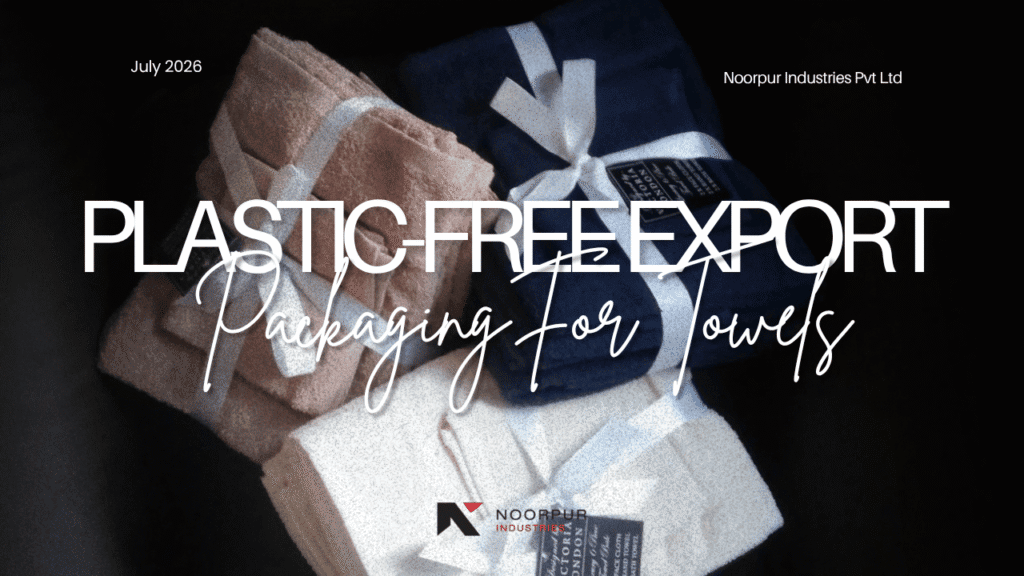
For international textile buyers, brand owners, and hospitality procurement directors exporting bath linens into European and Australian markets, packaging is no longer an afterthought—it is a central regulatory hurdle.
For decades, the global textile supply chain relied heavily on single-use polybags (LDPE/PP) to protect terry towels from dust, moisture, and handling friction during long ocean transits. However, sweeping legislative updates across the European Union, alongside Australia’s 2025 National Packaging Targets, are rapidly rendering non-recyclable plastic packaging obsolete.
Importers and retailers now face strict financial penalties, Extended Producer Responsibility (EPR) eco-contributions, and potential customs rejections if inbound shipments fail to meet stringent recyclability and circular economy mandates. Transitioning to plastic free packaging export towels europe compliant solutions is no longer just a sustainability commitment—it is a mandatory operational requirement.
At Noorpur Industries Pvt Ltd, we engineer end-to-end sustainable export solutions. From GOTS-certified organic cotton towel weaving to plastic-free primary and secondary packaging, we ensure your bulk shipments comply with evolving EU directives while maintaining pristine product protection across international freight routes.
The Regulatory Framework Driving Plastic-Free Packaging in Europe
To maintain seamless entry into EU member states and Australian ports, textile brands must align their packaging specifications with four core legislative pillars:
1. EU Packaging and Packaging Waste Regulation (PPWR)
The EU’s updated Packaging and Packaging Waste Regulation (PPWR) enforces aggressive targets to reduce packaging waste per capita across all member states. Key provisions affecting textile importers include:
- Mandatory Recyclability by 2030: All packaging placed on the EU market must be technically recyclable at scale.
- Minimization & Void Space Limits: Oversized packaging with excess air or void space is explicitly prohibited; secondary shipping cartons must closely conform to product volumes.
- Phasing Out Single-Use Plastics: Plastic wraps used purely for transport grouped packaging are subject to strict reduction quotas and increasing eco-taxes.
2. Extended Producer Responsibility (EPR) Schemes
Under EPR regulations enforced in countries like France (Refashion/CITEO), Germany (VerpackG / LUCID), and the Netherlands, brands placing packaged goods onto the market pay fees based on the recyclability of their packaging. Shipments utilizing non-recyclable plastic polybags face significant financial penalties, whereas mono-material paper, cardboard, and certified home-compostable packaging receive substantial fee reductions.
3. EU Directive on Single-Use Plastics (SUPD) & Green Claims Directive
The Green Claims Directive demands third-party verification for all environmental claims made on consumer-facing packaging. Phrases like “eco-friendly packaging” or “100% biodegradable” without certified laboratory proof (such as EN 13432 for compostability) trigger severe regulatory fines. Furthermore, plastic bans extend to non-essential plastic accessories, such as plastic kimble tags, nylon swift-tacks, and plastic hanger hooks.
4. Australia’s APCO and National Packaging Targets
Although operating under a separate jurisdiction, the Australian Packaging Covenant Organisation (APCO) mirrors European standards. Australia’s targets mandate $100\%$ reusable, recyclable, or compostable packaging, with $70\%$ of plastic packaging actively recycled or composted. Importers supplying major Australian retailers must comply with the Australasian Recycling Label (ARL) framework.
Comparing Conventional vs. Plastic-Free Export Packaging Solutions
Switching to a plastic free packaging export towels europe strategy requires replacing every layer of traditional packaging with high-performance, mono-material alternatives:
| Packaging Layer | Traditional Conventional Option | Compliant Plastic-Free Alternative | Regulatory & Commercial Advantage |
| Primary Protection | Polyethylene (LDPE) single-towel polybag | FSC-certified translucent Glassine Paper Bags or Paper Belly Bands | 100% curbside paper recyclable; exempt from plastic packaging taxes. |
| Group / Inner Packs | Heavy-duty Master Polybags (HDPE) | Kraft paper bundling wrap or woven cotton scrap ties | Mono-material disposal; eliminates single-use transport plastic. |
| Retail Tagging | Plastic Kimble tacks / nylon barbs | Organic Cotton Thread or FSC Paper Cord with paper hangtags | Eliminates microplastic shedding; fully biodegradable. |
| Carton Sealing | Plastic BOPP acrylic adhesive tape | Water-Activated Reinforced Kraft Paper Tape | Allows entire shipping carton to be recycled without manual tape separation. |
| Shipping Container | Double-wall corrugated box with plastic strapping | 100% Recycled Corrugated Cartons with paper banding | Fully compliant with EU PPWR void-ratio and material recycling directives. |
Overcoming Technical Challenges: Protecting Towels in Transit Without Plastic
The primary purpose of export packaging is ensuring products arrive in flawless condition. Towels are soft, moisture-absorbent textile goods vulnerable to humidity, dust, sea-freight condensation (“container rain”), and mechanical friction during multi-week ocean transport.
Removing plastic requires precise packaging engineering to preserve product integrity:
Managing Humidity and Sea-Freight Moisture
Transoceanic shipping subjects cargo containers to dramatic temperature fluctuations, causing moisture in the container air to condense. Traditional polybags trapped this moisture inside, leading to mildew formation.
- The Solution: Translucence-rated Glassine paper wraps and bio-based desiccant packs (such as natural clay or bentonite desiccants in paper pouches) allow controlled air breathability while absorbing excess ambient moisture, preventing mold growth without synthetic plastic films.
Preventing Soilage and Dust Accumulation
Unprotected terry loops act like magnets for environmental dust during warehouse handling and transit.
- The Solution: Utilizing full-enclosure FSC Kraft paper pouches or sealed glassine bags protects towel piles from dust and friction while allowing optical scannability of printed paper barcode labels.
Ensuring Barcode Scannability at European Logistics Hubs
Automated European fulfillment centers require high-contrast barcode scannability without removing the product from its protective sleeve.
- The Solution: Directly printing high-density QR codes and GS1 barcodes using soy-based inks onto paper belly bands or glassine surfaces ensures fast automated scanning across European logistics hubs.
Step-by-Step Transition Protocol for Export Procurement
Transitioning an entire towel supply chain from polybags to plastic-free export packaging requires a structured, step-by-step approach:
1.Map Environmental Compliance Requirements:Step 1: Audit Current Packaging & Destination Regulations.
Identify specific target country rules (e.g., German LUCID registry, French Triman logo mandates, or Australian ARL guidelines). Catalog all plastic components currently used—from master polybags down to hangtag fasteners.
2.Engineer Plastic-Free Packaging Specs:Step 2: Select Approved Mono-Material Paper Solutions.
Specify exact material GSM weights and certifications: select $40 – 60\text{ GSM}$ Glassine paper for primary wrapping, $120 – 180\text{ GSM}$ FSC Kraft paper for belly bands, and $100\%$ recycled corrugated master cartons.
3.Validate Moisture & Friction Stability:Step 3: Conduct Environmental Transit Simulation Tests.
Subject fully packaged sample cartons to climate-chamber humidity testing ($40^\circ\text{C}$ at $90\%$ relative humidity) and drop-friction tests to verify that paper wrappings maintain structural integrity during transit.
4.Incorporate Mandatory Recycling Logos:Step 4: Finalize Artwork & Regulatory Labeling.
Print mandatory sorting instructions directly onto paper packaging (such as the French Triman logo and sorting info) using water-based or soy-based non-toxic inks.
Why Partner with Noorpur Industries Pvt Ltd?
As a premier OEM/ODM manufacturer with over 50 years of textile export expertise, Noorpur Industries Pvt Ltd provides full-scope sustainable manufacturing and packaging integration:
- Custom Plastic-Free Packaging Development: We offer turnkey packaging options, including FSC-certified paper bands, glassine sleeves, organic cotton ribbon ties, and custom-printed recyclable corrugated boxes.
- Full Regulatory Alignment: Our export team ensures your packaging artwork and material compositions conform to EU PPWR, French Triman guidelines, German VerpackG regulations, and Australian APCO standards.
- Complete Product Certifications: Our towels and packaging setups align with GOTS (Global Organic Textile Standard), OEKO-TEX Standard 100, amfori BSCI, and ISO 9001/14001 standards.
- Streamlined Container Loading: We optimize master carton dimensions to maximize container fill rates, reducing transport carbon footprints while adhering to EU packaging volume limits.
Frequently Asked Questions (FAQs)
Are glassine paper bags fully recyclable in standard European paper waste streams?
Yes. Glassine is made from $100\%$ wood pulp without plastic coatings. It is fully repulpable and bio-degradable, making it curbside-recyclable alongside standard paper waste in all EU member states and Australia.
How do plastic-free paper wraps handle humidity during 30-day ocean transit?
High-density Glassine paper and unbleached Kraft paper possess natural air breathability that prevents trapped condensation inside the package. When paired with natural clay desiccant packs inside recycled shipping cartons, towels remain completely dry and odor-free throughout ocean transit.
What is the French Triman Logo, and is it mandatory on plastic-free towel packaging?
The Triman logo is a mandatory eco-label enforced in France under the AGEC Law. It informs consumers how to sort packaging waste. Even plastic-free paper belly bands or cardboard boxes exported to France must display the Triman symbol along with specific paper sorting instructions.
Does switching to plastic-free packaging significantly increase unit freight costs?
No. While specialty paper materials (like Glassine) may carry a slightly higher unit cost than cheap LDPE polybags, they eliminate heavy plastic packaging taxes and EPR penalties in Europe. Additionally, optimized paper belly bands reduce overall pack volume, allowing more units per pallet and offsetting freight costs.
Can Noorpur Industries customize plastic-free packaging with our brand’s logo and barcodes?
Yes. We offer complete custom OEM packaging. Logos, brand artwork, care instructions, and GS1 barcodes can be printed directly onto paper belly bands, glassine pouches, or cardboard boxes using eco-friendly soy- or water-based inks.