
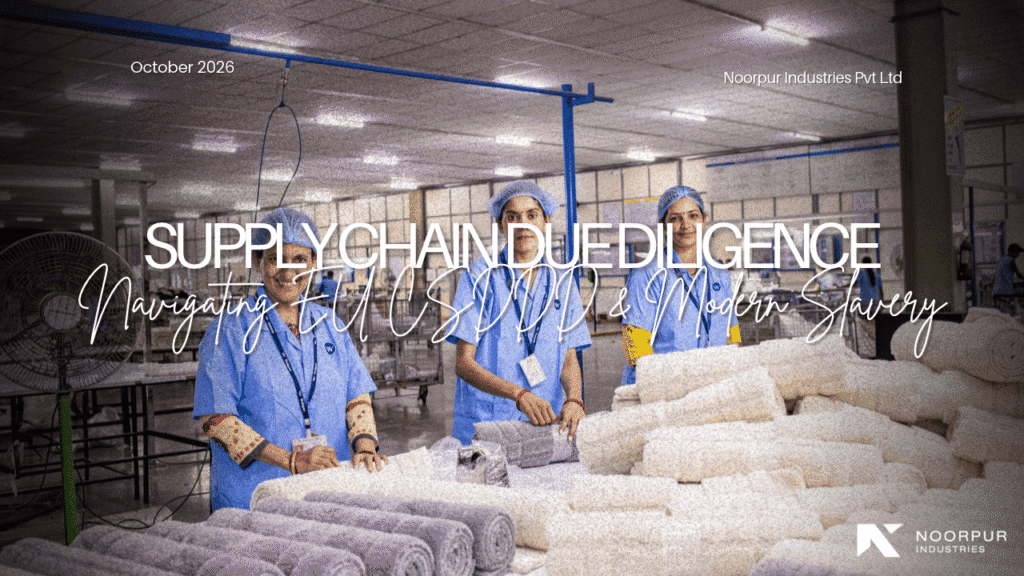
For Chief Procurement Officers (CPOs), Legal Counsel, and ESG Compliance Directors at major Australian retail groups, European department stores, and institutional hospitality chains, global textile procurement has shifted permanently from voluntary Corporate Social Responsibility (CSR) to legally binding statutory due diligence. Under the European Union Corporate Sustainability Due Diligence Directive (EU CSDDD – Directive (EU) 2024/1760), the EU Forced Labour Regulation (Regulation (EU) 2024/3015), the German Supply Chain Due Diligence Act (LkSG), and the Australian Modern Slavery Act 2018 (Cth), importing enterprises are legally accountable for human rights, living wage, workplace safety, and environmental risks across their multi-tier textile value chains.
Importing cotton terry towels, bathrobes, or hospitality linens without verifiable Tier-1 (cut-and-sew/stitching), Tier-2 (weaving and wet dyeing/finishing), and Tier-3 (spinning and cotton ginning) traceability exposes European and Australian buyers to severe statutory penalties – including public naming on government non-compliance registers, border detentions of goods suspected of forced labor, exclusion from public procurement tenders, and civil liability.
This technical B2B governance guide breaks down the regulatory mandates of the EU CSDDD, EU Forced Labour Regulation, and Australian Modern Slavery Act, maps out multi-tier cotton traceability protocols, compares accredited social compliance audits (SMETA 4-Pillar, amfori BSCI, and SA8000), and demonstrates how Noorpur Industries Pvt Ltd provides transparent, audit-ready vertical manufacturing from Karachi, Pakistan.
Regulatory Landscape: European & Australian Supply Chain Laws
Understanding how European Union and Australian statutory frameworks overlap allows global sourcing teams to build a single, unified supplier qualification standard that satisfies both jurisdictions.
Why Vertical Integration De-Risks Multi-Tier Textile Compliance
When European or Australian buyers purchase towels through fragmented trading brokers or non-vertical stitching workshops, the order passes through four or five unmonitored subcontractors – spinning mills, sizing units, power-loom sheds, third-party dye houses, and external stitching contractors. Every unmapped subcontractor creates a blind spot for forced labor, excessive overtime, child labor, or untreated wastewater discharge.
By contrast, partnering with a vertically integrated primary manufacturer like Noorpur Industries Pvt Ltd consolidates weaving, wet dyeing/finishing, shearing, stitching, and retail packaging inside a single audited facility – drastically reducing Tier-1 and Tier-2 compliance risk.
Multi-Tier Cotton Traceability: Mapping Tier-1 to Tier-4
Both European customs authorities enforcing the EU Forced Labour Regulation and Australian ESG auditors require documented proof that raw cotton fibers were not harvested or processed in high-risk regions linked to state-imposed forced labor.
For detailed insights on certified organic and recycled fiber chain-of-custody documentation, review our guides on OEKO-TEX & GOTS Certified Towel Manufacturers in Pakistan and GRS-Certified Recycled Cotton Towel Manufacturing.
Accredited Social Compliance Audits: SMETA, BSCI & SA8000
To satisfy board-level ESG committees and statutory due diligence reporting without sending internal legal teams to inspect every mill monthly, European and Australian buyers rely on internationally recognized third-party audit frameworks conducted by accredited bodies (such as SGS, Intertek, Bureau Veritas, or TÜV).
1. Sedex SMETA 4-Pillar Audit (Preferred by UK & Australian Retailers)
SMETA (Sedex Members Ethical Trade Audit) is the most widely accepted social audit format across British supermarkets, Australian retail groups, and international homeware brands. A SMETA 4-Pillar assessment evaluates:
- Labor Standards: Zero forced/bonded labor, strict age verification (no child labor), documented employment contracts, legal overtime caps, and timely wage disbursement.
- Health & Safety: Structural building integrity, unobstructed emergency exits, fire suppression systems, machine guarding on high-speed looms, and PPE provision in wet dye houses.
- Environment (Extended Pillar): Effluent water treatment compliance, hazardous chemical storage, and waste management.
- Business Ethics: Anti-bribery, anti-corruption, and transparent record-keeping.
2. amfori BSCI (Preferred by Continental European Importers)
Across Germany, the Netherlands, France, Belgium, and Scandinavia, amfori BSCI (Business Social Compliance Initiative) is the standard supply chain monitoring system. Evaluated on an A to E rating scale across 13 Performance Areas – including Fair Remuneration, Decent Working Hours, and No Bonded Labor – BSCI audit reports are shared directly via the amfori Sustainability Platform for seamless EU CSDDD reporting.
3. ISO 9001 & ISO 14001 Management Systems
Complementing social audits, ISO 9001 (Quality Management) and ISO 14001 (Environmental Management) verify standardized operational governance, traceable batch quality control, and continuous reduction of water and energy intensity per kilogram of finished terry cloth.
For a practical checklist on evaluating mill audit reports and conducting on-site or virtual inspections, explore our guide on How to Conduct On-Site and Virtual Factory Audits for Pakistani Towel Mills.
Environmental Due Diligence & Effluent Treatment in Wet Processing
Under EU CSDDD Article 7 and Annex Part II, corporate due diligence is not limited to labor rights – it explicitly mandates preventing and mitigating adverse environmental impacts, particularly water pollution and hazardous chemical discharge from textile dyeing and finishing.
When qualifying a Pakistani towel manufacturer for European or Australian distribution, ESG teams should verify three critical environmental controls:
- Functional Effluent Treatment Plant (ETP): Dye house wastewater must undergo primary physical screening, secondary biological/aerobic treatment, and chemical neutralization so discharged effluent meets national environmental quality standards (NEQS) for pH, Chemical Oxygen Demand (COD), and Biological Oxygen Demand (BOD).
- Azo-Free & Heavy-Metal-Free Dye Chemistry: Strict adherence to OEKO-TEX® Standard 100 and EU REACH Annex XVII restrictions ensures zero carcinogenic aromatic amines, formaldehyde, or toxic heavy metals enter wastewater streams or remain on finished towels.
- Closed-Loop Water & Heat Recovery: Modern soft-flow dyeing machines with low liquor ratios (1:5 to 1:6) and heat-exchanger recovery systems cut freshwater consumption and carbon emissions per tonne of dyed terry cloth by up to 35%.
Step-by-Step Supplier Onboarding Checklist for EU & Australian Buyers
Before issuing a purchase order to any overseas textile manufacturer, procurement and compliance officers should execute a structured five-step due diligence workflow:
- Collect Baseline Governance & Audit Dossiers: Request active SMETA / BSCI audit reports (including Corrective Action Plan Reports – CAPRs), OEKO-TEX® Standard 100 certificates, and ISO 9001 credentials.
- Verify Sub-Tier Disclosure: Require written confirmation of where spinning, weaving, dyeing, and stitching occur, ensuring zero unauthorized subcontracting.
- Mandate Fiber Origin Traceability: For organic or recycled collections, require GOTS or GRS Scope Certificates upfront and mandate shipment-specific Transaction Certificates (TCs) prior to final balance payment.
- Execute Mutual Supplier Code of Conduct: Bind the manufacturer contractually to ILO Core Conventions, living-wage progression, worker grievance mechanisms, and anti-forced-labor warranties.
- Conduct Pre-Shipment Third-Party Inspection: Engage an accredited inspection agency (SGS, Intertek, or Bureau Veritas) to verify finished goods quality, statutory EU/AU fiber labeling, and carton counts prior to container sealing.
Partner with Noorpur Industries for Transparent, Audit-Ready Sourcing
Operating in Karachi, Pakistan for over 50 years, Noorpur Industries Pvt Ltd provides European, UK, and Australian retailers, hospitality groups, and institutional distributors with full supply chain visibility, ethical manufacturing governance, and certified product quality.
How Noorpur Industries Supports Your ESG & Compliance Mandates:
- Full Audit Transparency: Open-door policy for buyer compliance teams and accredited third-party auditors (SGS, Intertek, Bureau Veritas) across weaving, wet dyeing, stitching, and packing departments.
- Certified Chemical & Fiber Traceability: Active compliance with OEKO-TEX® Standard 100, GOTS Organic, GRS Recycled, and ISO 9001, complete with batch-level Transaction Certificates for every export shipment.
- Duty-Free Trade Eligibility: Qualifying Pakistani textiles enter the European Union at 0% import duty (GSP+) and the United Kingdom at 0% import duty (DCTS) – enabling European and British enterprises to meet strict ESG standards while saving 12% on import tariffs.
- Reliable Australian & European Export Execution: Decades of experience serving major retail and hospitality importers across Germany, the Netherlands, France, the UK, Australia, and North America.
For complete details on export documentation, tariffs, and transit timelines, review our guides on Shipping Towels from Pakistan to Europe & UK and Importing Towels from Pakistan to Australia.
Request Our Compliance Dossier & Ethical Sourcing Profile
Prepare your upcoming supplier qualification review or Modern Slavery Statement with complete confidence. Contact our commercial export and compliance team today to request Noorpur Industries’ current audit credentials, fiber traceability documentation, or a tailored B2B quotation:
- Official Website: https://noorpur.com.pk
- Request Compliance Credentials & Quotations: Contact Noorpur Industries Export Team