
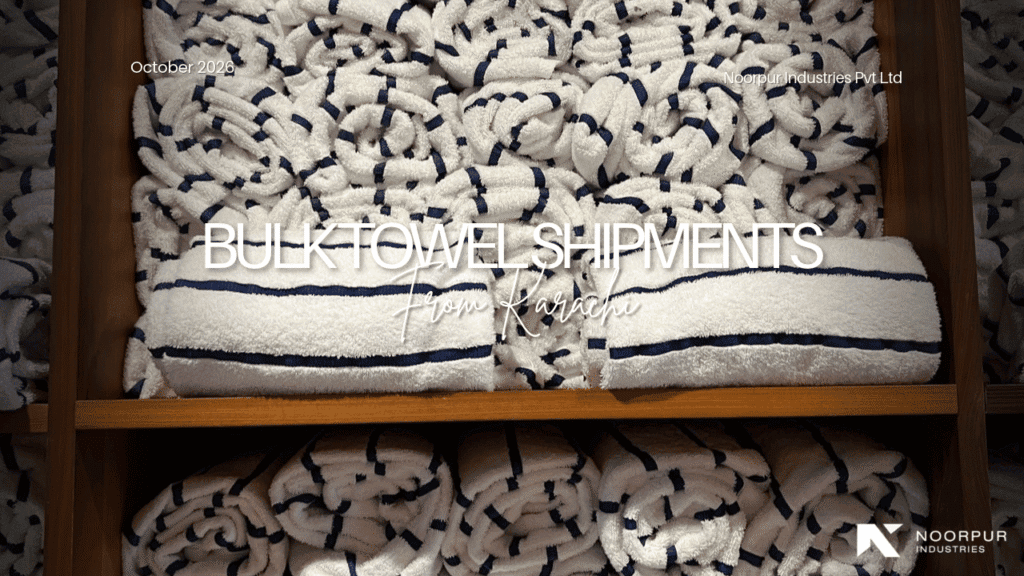
For supply chain managers, import/export logistics coordinators, wholesale textile distributors, and first-time international buyers across Europe, the United Kingdom, and Australia, ocean freight and customs structuring directly determine final landed unit cost. Unlike high-density commodities such as steel or ceramics, cotton terry towels are volumetric cargo – meaning a shipping container reaches its physical cubic capacity (CBM) long before hitting its maximum payload weight limit.
Importing uncompressed retail-boxed bath sheets in loosely packed cartons wastes up to 35% of available container space, inflating per-unit sea-freight costs across the Karachi-to-Europe or Karachi-to-Australia trade lanes. Simultaneously, selecting the wrong ICC Incoterms® 2020 rule – such as defaulting to DDP when importing into the European Union or Australia without local VAT/GST registration, or misunderstanding where risk transfers under CIF – can trigger unexpected port demurrage, customs clearance bottlenecks, and uninsured marine cargo exposure.
This technical B2B logistics guide provides exact 20ft GP, 40ft GP, and 40ft High-Cube (HC) container loading capacities for terry towels, compares vacuum-compressed bale packing vs. 5-ply master cartons, breaks down FOB, CIF, DAP, and DDP Incoterms® 2020 rules for European and Australian importers, and outlines transit schedules and biosecurity protocols from Karachi / Port Qasim with Noorpur Industries Pvt Ltd.
Volumetric Container Capacity: 20ft GP vs. 40ft GP vs. 40ft High-Cube
Because terry cotton loops trap significant air volume, maximizing cubic meter (CBM) utilization is the single fastest way to reduce ocean freight cost per towel. For textile importers, the 40ft High-Cube (40′ HC) container – which provides an extra foot of vertical height ($2.69\text{ m}$ internal height vs. $2.39\text{ m}$ in a standard 40ft) – delivers 12% to 15% more cargo volume for only a marginal increase in ocean freight rate.
Note on Mixed-SKU Container Consolidation: Noorpur Industries Pvt Ltd engineers custom container load plans (3D stuffing diagrams) prior to packing – allowing European and Australian buyers to combine heavy bath sheets, hand towels, bath mats, bathrobes, and lightweight kitchen cloths into a single FCL shipment with zero wasted headroom.
Packaging Engineering: Export Bales vs. 5-Ply Master Cartons
Selecting the right export packing format balances ocean freight economy against warehouse handling requirements and retail shelf presentation upon arrival.
For detailed insights on retail-ready belly bands, EU PPWR recyclability rules, and carton empty-space compliance, review our guide on Sustainable Retail Packaging and EU PPWR Compliance for Exported Textile Collections.
Incoterms® 2020 Breakdown: FOB vs. CIF vs. DAP vs. DDP
Choosing the optimal ICC Incoterms® 2020 rule defines who controls main ocean freight booking, when physical cargo risk transfers during transit, and who manages import customs clearance.
Critical Tax & Risk Insights for European & Australian Importers
- Why DAP Beats DDP for EU, UK & Australian Registered Businesses: Under DDP, the overseas exporter is responsible for paying destination Import VAT (19%–21% in the EU, 20% in the UK) or Australian GST (10%). Because a foreign manufacturer is not locally VAT/GST-registered in your country, that import tax becomes an unrecoverable sunk cost built into your quote. By purchasing on FOB, CIF, or DAP terms, your company acts as the Importer of Record (IOR)—allowing you to reclaim 100% of Import VAT/GST on your routine tax filing (or defer it via Postponed VAT Accounting in the UK).
- Understanding CIF Risk Transfer & Insurance Upgrades: Many buyers assume that under CIF, the seller bears marine transit risk until the ship docks in Rotterdam, Hamburg, or Sydney. Under ICC Incoterms® 2020, risk passes to the buyer the moment the container crosses the ship’s rail in Karachi, and standard CIF requires only minimum Institute Cargo Clauses (C) cover. Always request Institute Cargo Clauses (A) “All-Risk” insurance (covering freshwater/condensation damage and pilferage) on textile shipments.
Sea-Freight Routes, Transit Schedules & Biosecurity Protocols
Direct and weekly mainline services connect Karachi Port (KICT / SAPT) and Port Qasim (QICT) to major European, UK, and Australian container ports:
Australian Department of Agriculture (DAFF) Biosecurity Checklist
Australia enforces the world’s strictest maritime biosecurity rules via the Department of Agriculture, Fisheries and Forestry (DAFF). To prevent costly container fumigation or re-export orders at Australian ports:
- ISPM-15 Certified Pallets Only: Any wooden pallets or dunnage must carry legible ISPM-15 heat-treatment stamps backed by a valid Phytosanitary / Fumigation Certificate – or use plastic pallets / floor-loaded cartons to bypass timber inspections entirely.
- Container Cleanliness & Moisture Control: Every container stuffed at Noorpur Industries undergoes a pre-loading floor/wall sweep inspection and is fitted with high-capacity calcium chloride container desiccants to prevent “container rain” condensation during tropical sea transit.
For region-specific tariff and customs guides, explore our dedicated resources on Shipping Towels from Pakistan to Europe & UK, UK DCTS Duty-Free Towel Importing, and Importing Towels from Pakistan to Australia.
Streamline Your Next Bulk Towel Shipment with Noorpur Industries
Operating in Karachi, Pakistan for over 50 years, Noorpur Industries Pvt Ltd manages end-to-end export logistics for retail chains, hospitality groups, and wholesale textile distributors across Europe, the United Kingdom, and Australia.
Partnering with Noorpur Industries Delivers:
- Custom Container Load Optimization: Pre-shipment 3D cubic load planning combining compressed bales or 5-ply master cartons to maximize 20ft and 40ft High-Cube efficiency.
- Flexible Incoterms® 2020 Execution: Seamless support across FOB Karachi, CIF Destination Port, and DAP Warehouse Door terms, paired with Institute Cargo Clauses (A) all-risk marine insurance options.
- Zero-Delay Customs Documentation: Accurate EU GSP+ REX, UK DCTS Origin Declarations, Australian DAFF Packing Declarations, and third-party pre-shipment inspection reports (SGS / Intertek / Bureau Veritas).
Contact our commercial export and logistics team today to request a custom container load calculation or a comparative FOB/CIF quotation for your target destination port:
- Official Website: https://noorpur.com.pk
- Request Container Quotes & Logistics Plans: Contact Noorpur Industries Export Team