
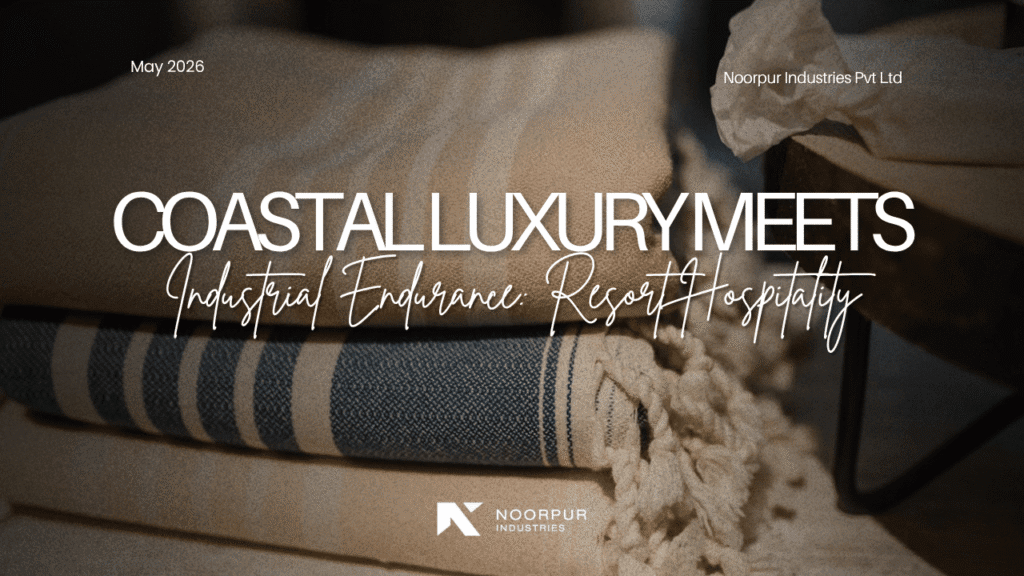
The Australian resort and premium hospitality landscape faces an environmental and operational reality unlike any other market in the world. From the sun-bleached coastal luxury of Queensland’s Whitsunday Islands and the luxury boutique hotels tucked into Melbourne’s creative laneways, to the high-exposure beach clubs lining Sydney’s iconic coastline, the demands placed on commercial textiles are uniquely brutal.
A beach towel or a poolside bath linen in these environments must withstand intense, unrelenting UV radiation, constant exposure to abrasive sea salt and chlorine, and a relentless cycle of heavy commercial laundering. At the same time, it must continuously offer an uncompromised tactile experience that satisfies the sensory expectations of a discerning domestic and international traveler.
For commercial housekeepers, procurement directors, and resort asset managers across Australia, selecting commercial bath and beach linens is no longer a generic purchasing routine. Instead, it has evolved into a strategic balancing act where the key metrics are textile durability, brand reputation, and environmental responsibility.
As corporate accountability standards and modern ESG expectations tighten across the Commonwealth, properties can no longer rely on standard retail-grade textile imports. To build a reliable, high-performance linen pool that lowers operational costs while elevating the guest experience, the Australian hospitality sector is shifting toward a highly technical solution: Custom Branded Towels for Hotels Australia engineered by specialized, vertically integrated textile manufacturers.
The Chemistry of Coastal Preservation: Indanthrene Dyeing vs. UV and Chlorine Degradation
In Australia’s high-exposure leisure hospitality spaces, color performance is a critical element of brand representation. Whether a property features signature charcoal resort robes, deep slate pool towels, or vibrant striped beach linens designed to capture the classic coastal look, these textiles face intense bleaching hazards.
When a standard commercial towel comes into contact with the trio of intense Australian sunlight, chlorinated pool water, and harsh guest skincare products – such as zinc-based sunscreens or benzoyl peroxide acne treatments – it undergoes a rapid chemical oxidation process. The results are instantly noticeable: unpresentable orange discoloration, fading color patches, and patchy graying. For a luxury property, a stained or bleached towel is an operational failure that can lead to negative reviews and damaged guest trust.
Standard Reactive Dye Process (Surface Bond Only):
[Yarn Core] ➔ [Surface Dye Coating] ➔ Exposed to UV/Chlorine ➔ Structural Bond Fails ➔ Fading/Bleaching

Advanced Indanthrene Dyeing (Intra-Cellular Bond):
[Yarn Core 🧬 Interlocked Dye Molecules] ➔ Exposed to UV/Chlorine ➔ Molecular Bond Holds ➔ Color Integrity Maintained
To prevent this premature asset failure, premium institutional textiles utilize an advanced chemical process known as Indanthrene dyeing. Unlike conventional reactive dyes, which merely form a surface coat on the cotton fibers, Indanthrene dyes belong to a highly stable class of vat dyes. This specialized manufacturing technique introduces water-insoluble dye molecules deep inside the core structure of the cotton cellulose fibers, creating a permanent molecular bond that is locked in from within.
For Australian resort managers, this technical execution delivers major operational advantages:
- Total Chlorine Resistance: Indanthrene-dyed towels can undergo intensive high-temperature sanitization wash cycles alongside industrial-strength sanitizers without running, bleeding, or losing color depth.
- Maximum UV Fastness: The chemical stability of the dye resists the intense bleaching effects of prolonged southern-hemisphere solar radiation, ensuring that pool and beach textiles look as vibrant and premium on day one hundred as they did on day one.
- Chemical Protection: The permanent molecular bond prevents the unsightly chemical bleaching typically triggered by guests’ sunscreens and skin treatments, extending the aesthetic life of the towel and keeping it in active service far longer.
Loop Dynamics: Unlocking Quick-Drying Performance in High-Volume Resorts
The financial health of an industrial linen pool is fundamentally tied to the physics of water management. In a bustling beachfront resort or high-capacity urban hotel, towels are continuously rotated from the guest suite or poolside deck directly back to the commercial laundry. This intensive workflow demands a textile that absorbs moisture instantly, yet releases it efficiently during the automated drying process to prevent operational bottlenecks.
Solving this challenge requires a careful shift away from single-loop terry weaves toward an advanced double-loop ring-spun construction.
Single-Loop Weave Architecture (Retail Standard):
╭╮  ╭╮  ╭╮  ╭╮  ╭╮
┃┃  ┃┃  ┃┃  ┃┃  ┃┃  <-- Loose, long loops that snag easily and flatten under mechanical pressure.
==================

Double-Loop Ring-Spun Architecture (Institutional Standard):
 get get get get get
┃┃  ┃┃  ┃┃  ┃┃  ┃┃  <-- Twisted, interlocking yarns that stand erect, maximizing airflow and capillary action.
==================
By twisting two premium, long-staple combed cotton yarns together to form a single, structurally reinforced loop, the total effective surface area of the fabric is instantly doubled. This architectural layout creates an immediate capillary effect when it touches wet skin, trapping moisture effortlessly without requiring heavy rubbing or causing skin friction.
Crucially, this design also addresses thermal efficiency. While consumer marketing often associates a heavy, dense feel with luxury, a heavy, unengineered 800 GSM towel is poorly suited for commercial applications. It acts as a dense sponge, trapping water tightly within its core and requiring prolonged, high-heat drying cycles that over-process the fabric, fracture the fibers, and drive up energy bills.
By engineering a targeted 550 to 650 GSM profile using a breathable double-loop weave, manufacturers create a towel with excellent loft and volume that allows hot air to circulate freely through the fabric core during automated drying cycles. This shortens laundry processing windows, drastically cuts utility consumption, and minimizes a property’s scope 3 carbon footprint, helping operators meet modern sustainability goals.
Mitigating Operational Waste: Structural Balancing and Border Shrinkage Prevention
One of the most frustrating maintenance issues for housekeeping teams is border shrinkage – the distortion known as “bunching” or “bowing” where a flat-woven decorative border shrinks faster than the main terry body, warping a premium towel into an awkward, asymmetrical shape. A distorted towel cannot be neatly folded or displayed, forcing properties to pull otherwise intact linens out of service prematurely.
+-----------------------------------------------------------+
|          TECHNICAL ANATOMY OF AN ENDURING TURKISH WEAVE    |
+--------------------------+--------------------------------+
| Engineering Feature      | Operational Outcome            |
+--------------------------+--------------------------------+
| 100% Long-Staple Cotton  | Eliminates linting & pilling   |
| Tension-Matched Weaving  | Prevents border shrinkage      |
| Double-Lock Hems         | Stops unraveling & edge-fraying|
| Indanthrene Vat Dyeing   | 100% Chlorine & UV resistance  |
+--------------------------+--------------------------------+
This structural failure occurs because generic retail towels feature decorative headers woven under entirely different yarn tensions than the surrounding loops. When subjected to the high temperatures of commercial laundering, these different zones contract unevenly.
Preventing this visual distortion requires precise tension-matching technology on automated looms. High-performance institutional towels are woven with flat headers engineered to match the exact shrinkage coefficients of the primary terry body.
By pairing this tension control with reinforced selvages and double-lock stitched hems, the entire towel expands and contracts uniformly. Even after more than 150 intensive wash-and-dry cycles, the linen keeps its clean, rectangular geometry and sits flat on the vanity, cutting down on the labor time housekeepers spend attempting to straighten out warped edges.
Calculating the True Financial Blueprint: Sourcing vs. Intermediary Costs
For corporate procurement executives managing large hospitality groups, calculating the true value of a textile asset means shifting away from initial checkout pricing to evaluate the Total Cost of Ownership (TCO) over the entire lifetime of the product.
Purchasing low-cost, retail-grade towels constructed from short-staple carded yarns might show a brief saving on an opening purchase order. However, these fragile fibers degrade rapidly under institutional washing, exhibiting thinning centers, loose threads, and fraying edges within 70 to 90 laundry cycles. For a high-occupancy resort, this translates to frequent, expensive replacement cycles that drain operational budgets.
Linen Pool Longevity Curve (Commercial Laundering Agitation):
Cycles:      0       50      100     150     200     250
Ring-Spun:   [=========================================] 220+ Cycles (Pristine Loft)
Carded Yarn: [====================] 80 Cycles (Frayed/Thin)
By contrast, an institutional towel engineered from long-staple ring-spun combed cotton routinely delivers an active operational lifespan of 180 to 220+ high-velocity commercial wash cycles. By doubling the service life of the textile pool, properties cut their annual replenishment expenditures in half, full amortize their initial investment, and avoid the logistical headaches of frequent inventory replacement.
Furthermore, by stepping away from generic intermediary brokers to establish direct partnerships with Pakistani towel suppliers Australia, enterprise buyers bypass hidden distributor markups. Direct-from-manufacturer sourcing gives properties access to factory-direct pricing, custom weight calibrations, tailored border headers, and reliable, predictable production windows that protect the supply chain from unexpected disruptions.
Protecting Brand Loyalty through Tangible Quality
Ultimately, investing in premium institutional linens is a direct investment in guest loyalty. In a premium resort environment, the bath towel or poolside beach sheet is one of the most frequent, tactile interactions a guest has with the brand during their stay. Providing a thin, scratchy, or frayed towel introduces a moment of friction that can quietly detract from an otherwise exceptional vacation.
By providing a thick, enveloping, and naturally soft towel that has been structurally engineered to stay plush without relying on chemical fabric softeners, a property reinforces its commitment to luxury and attention to detail. This focus on premium quality protects guest satisfaction, drives five-star reviews, and positions the brand as a leader in Australia’s competitive luxury market.