
When procurement heads, healthcare buying groups, and hotel linen distributors source commercial towels in bulk, quality assurance isn’t an afterthought—it is the foundation of risk management. A single shipment containing structural defects, inconsistent Grams per Square Meter (GSM), or shade variations can lead to costly stock rejections, store returns, and damaged brand reputations.
To mitigate cross-border supply chain risks, international buyers rely on standardized statistical sampling protocols. Chief among these is the Acceptable Quality Limit (AQL), defined by ISO 2859-1 (or ANSI/ASQ Z1.4). In commercial textile manufacturing, aql 2 5 inspection standards bulk towels serve as the benchmark for balancing strict quality control with cost-effective production.
At Noorpur Industries Pvt Ltd, we engineer our export production workflows around international AQL quality matrices. This comprehensive guide breaks down how AQL 2.5 functions, how statistical sample lots are drawn, and how quality control officers classify defects in large-scale towel shipments destined for Europe, Australia, and North America.
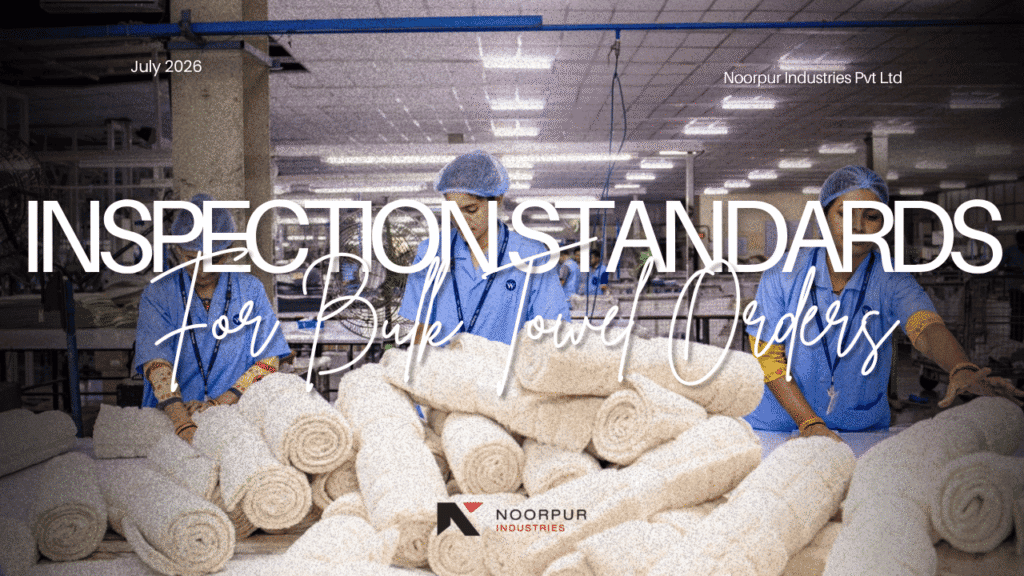
Textile Quality Inspection Team Reviewing Finished Export Towels Against ISO Standards. Source: CFOTO / CFOTO/Future Publishing via Getty Images
What is AQL 2.5 in Bulk Textile Procurement?
The Acceptable Quality Limit (AQL) represents the maximum proportion of defective units considered acceptable in a random statistical sample drawn from a manufacturing batch. AQL does not mean a manufacturer aims to produce 2.5% defective goods; rather, it provides a statistically sound threshold where a total production lot is either accepted or rejected upon pre-shipment inspection (PSI).
When an order specifies AQL 2.5 Major / AQL 4.0 Minor, it establishes distinct acceptance thresholds based on defect severity:
- Critical Defects (AQL 0.0): Zero tolerance allowed. Any defect that presents a safety hazard, violates biosecurity laws, or renders the product unusable results in immediate lot failure.
- Major Defects (AQL 2.5): The primary benchmark for functional or commercial failure. Represents non-conformities that impair the product’s performance, durability, or resale value (e.g., severe pile loops pulled, wrong dimensions, hem unraveling).
- Minor Defects (AQL 4.0): Minor cosmetic blemishes or slight finish imperfections that do not affect the towel’s overall usability or structural integrity (e.g., loose un-trimmed threads, minor polybag crinkling).
AQL Defect Classification Hierarchy:
[ Critical Defects: 0.0 ] -> Safety Hazards / Legal Violations (Immediate Lot Rejection)
[ Major Defects: 2.5 ]    -> Functional Failures / Structural Blemishes (AQL 2.5 Benchmark)
[ Minor Defects: 4.0 ]    -> Surface Cosmetic Imperfections (Acceptable up to higher threshold)
Demystifying ISO 2859-1: How Sampling Tables Work
Determining how many towels to inspect out of a 10,000-piece container load relies on standard ISO 2859-1 Single Sampling Plans (General Inspection Level II).
Step 1: Code Letter Determination
First, match the total production lot size with the corresponding Sample Size Code Letter under General Inspection Level II.
Step 2: Sample Extraction & Acceptance/Rejection Limits
Once the code letter is identified, cross-reference it with the AQL 2.5 and AQL 4.0 columns to establish the exact number of allowed defective units:
| Production Lot Size (Pieces) | Sample Size Code Letter | Inspection Sample Size | AQL 2.5 Major (Accept / Reject) | AQL 4.0 Minor (Accept / Reject) |
|---|---|---|---|---|
| 1,201 – 3,200 | K | 125 pcs | Accept ≤7 / Reject ≥8 | Accept ≤10 / Reject ≥11 |
| 3,201 – 10,000 | L | 200 pcs | Accept ≤10 / Reject ≥11 | Accept ≤14 / Reject ≥15 |
| 10,001 – 35,000 | M | 315 pcs | Accept ≤14 / Reject ≥15 | Accept ≤21 / Reject ≥22 |
| 35,001 – 150,000 | N | 500 pcs | Accept ≤21 / Reject ≥22 | Accept ≤21 / Reject ≥22 |
Practical Example: If an Australian resort chain orders 10,000 bath towels, an auditor randomly selects 200 towels across different cartons. If the inspector finds 10 or fewer major defects, the lot passes. If 11 major defects are found, the entire 10,000-piece lot is rejected and sent back for 100% re-sorting and repair.
Key Defect Classifications in Towel Quality Audits
During a Pre-Shipment Inspection (PSI), third-party auditing firms (such as SGS, Bureau Veritas, or QIMA) evaluate bulk towel orders across physical, visual, and dimensional criteria.
Laboratory Testing for Fabric Absorbency, GSM Weight, and Spectrophotometer Color Consistency. Source: Textile Blog
1. Structural & Weaving Defects (Major)
- Skipped Loops / Drop Stitches: Missing terry loops that leave visible bare patches in the fabric base.
- Hem Unraveling: Loose or broken stitching along the double-needle side or header hems.
- Dobby / Jacquard Distortion: Bowing, skewing, or misaligned border patterns exceeding 1.5% of total width.
- Oil & Dye Stains: Lubricant spots from weaving looms or un-level dye spots on finished fabric.
2. On-Site Physical Tests & Functionality (Major/Critical)
Beyond visual inspection, AQL protocols require functional field tests performed on a subset of the pulled sample:
- GSM Weight Verification: Individual towels must meet target weight within a strict tolerance (±3% to ±5%). A batch falling consistently below target GSM fails the specification contract.
- Absorbency Rate Test (AATCC 79): A water drop placed on the towel surface must be completely absorbed within 3 seconds (commercial benchmark).
- Colorfastness to Rubbing/Washing (ISO 105-X12): Evaluates color bleed or crocking. Minimum acceptable rating is Grade 4 on the Grey Scale for European markets.
- Needle Detection Check: 100% of finished goods pass through industrial needle detectors to prevent broken metal fragment contamination in export cartons.
3. Packaging & Labeling Non-Conformities (Major/Minor)
- Missing / Incorrect Country of Origin (Major): Failure to include “Made in Pakistan” on care labels causes immediate customs seizure in Australian (ABF) and European ports.
- Incorrect Barcode Scannability (Major): EAN-13 or UPC barcodes that fail scanner verification at distribution warehouses.
- Moisture Content Exceeding 8.5% (Major): Internal humidity higher than 8.5% inside sealed bags creates mold risk during multi-week ocean transit.
Implementing In-Line Quality Control to Guarantee AQL 2.5 Compliance
Relying solely on final pre-shipment inspection is a risky strategy. At Noorpur Industries Pvt Ltd, we prevent defect generation during active production by embedding AQL checkpoints across four distinct manufacturing stages:
- Incoming Raw Material Inspection (IQC): Testing raw cotton yarn for tensile strength, yarn count uniformity, and trash content before loading onto warping creels.
- Greige Fabric Inspection (4-Point System): Inspecting raw woven terry rolls on illuminated fabric-checking machines using the standard ASTM D5430 4-Point System prior to dyeing.
- In-Line Wet Processing & Finishing Checks (IPQC): Monitoring dye-house liquor ratios, pH levels, and drying temperatures to eliminate shade batch variation.
- Final 100% Metal Detection & Sorting (FQC): Manual end-of-line checking, thread trimming, and automated packing before generating final internal AQL reports.
Why European and Australian Buyers Trust Noorpur Industries
Navigating stringent import guidelines in Australia (AS/NZS standards) and the European Union (REACH regulations) requires a manufacturing partner with transparent QA protocols:
- In-House Testing Laboratories: Fully equipped facilities to perform tensile strength, GSM calculation, linting, colorfastness, and dimensional stability tests post-wash.
- Full Traceability: Every export bale or carton features batch tracking codes linking finished goods to yarn lot numbers and dyeing vessel logs.
- Third-Party Audit Readiness: Facilities structured for seamless third-party auditing by SGS, Intertek, Bureau Veritas, or customer-appointed inspection agencies.
- Certifications: Fully compliant with OEKO-TEX Standard 100, GOTS (for organic cotton lines), BSCI, and ISO 9001:2015.
Frequently Asked Questions (FAQs)
What is the difference between AQL 1.5, AQL 2.5, and AQL 4.0?
The numbers indicate the maximum allowable percentage of defective items in a sampling lot. AQL 1.5 represents a stricter quality standard (fewer allowed defects), commonly used for luxury goods or critical components. AQL 2.5 is the global industry standard for major defects in commercial textiles, while AQL 4.0 is typically reserved for minor cosmetic flaws.
Can an order pass inspection if it fails AQL 2.5 for Major Defects?
No. If the number of major defects found during sampling exceeds the rejection number listed in the ISO 2859-1 table, the shipment fails inspection. The factory must then re-check 100% of the production lot, replace or repair defective items, and schedule a re-inspection.
Who pays for third-party AQL inspections on bulk towel orders?
Typically, the buyer hires and pays for the third-party inspection agency (such as SGS or QIMA) for the initial Pre-Shipment Inspection (PSI). However, sales contracts usually specify that if the shipment fails the initial inspection, the supplier covers all costs for subsequent re-inspections.
How is the sample selected during an AQL inspection?
Samples must be selected 100% randomly from across the entire order. The inspector must have access to at least 80% of the completed and packed cartons, pulling samples from the top, middle, and bottom tiers of various pallets to ensure statistical accuracy.
What happens if a shipment passes AQL inspection but defects are discovered upon arrival?
AQL sampling provides 95% statistical confidence, but because it evaluates a sample lot rather than 100% of goods, minor statistical margins exist. Working with certified exporters like Noorpur Industries ensures comprehensive warranty terms and post-delivery support in the rare event of hidden manufacturing non-conformities.