
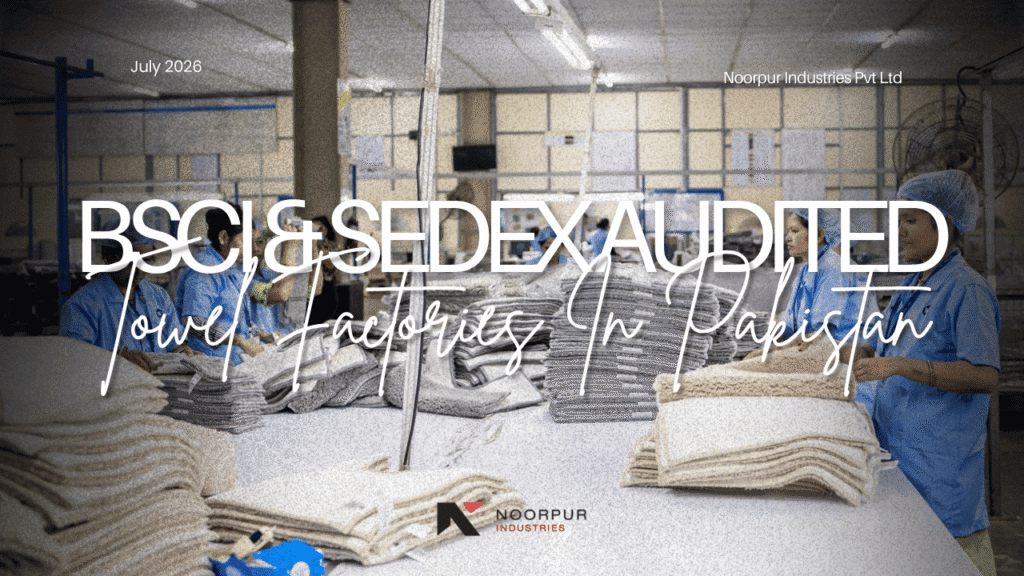
For global textile buyers, retail brand managers, and procurement leaders across Europe and Australia, sourcing home textiles has fundamentally changed. Price and product specs remain vital, but ethical compliance, social accountability, and audit transparency now dictate whether a shipment can clear customs, enter major retail distribution channels, or uphold a brand’s public reputation.
In the international terry towel trade, Pakistan stands as a manufacturing powerhouse—famed for high-grade ring-spun cotton yarns, absorbent weave engineering, and competitive scale. However, discerning buyers know that not all suppliers operate under equal ethical standards. Navigating vendor selection requires partnering with a certified bsci sedex audited towel factory pakistan importers can trust to meet stringent international labor and environmental mandates.
At Noorpur Industries Pvt Ltd, we have operated at the intersection of traditional textile craftsmanship and rigorous international compliance for over five decades. This comprehensive guide explores why BSCI and Sedex audits are indispensable for sourcing in Europe and Australia, how these frameworks safeguard your supply chain, and what to look for when vetting a manufacturing partner in Pakistan.
Why Ethical Audits Matter in Modern Textile Procurement
The modern consumer in Sydney, London, Frankfurt, or Paris expects the bath sheet or luxury hotel towel they use to be produced without exploitation, environmental dumping, or unsafe labor conditions. In response, European and Australian regulators have codified these expectations into strict legal frameworks:
- EU Corporate Sustainability Due Diligence Directive (CSDDD): Mandates that European importers actively prevent, identify, and remediate human rights and environmental risks across their global supply chain tiers.
- Australian Modern Slavery Act 2018: Requires Australian businesses with revenue exceeding AUD $100M to report annually on modern slavery risks in their operations and supply chains.
- German Supply Chain Due Diligence Act (LkSG): Enforces legal accountability on companies for worker rights violations and environmental hazards at direct supplier facilities.
Relying on self-audited supplier claims or unverified factory photos is no longer a viable procurement strategy. Third-party, standardized ethical audits provide the independent verification required to satisfy customs authorities, insurance underwriters, and corporate governance boards.
Understanding the Benchmarks: BSCI vs. Sedex SMETA
While both frameworks evaluate social and environmental responsibility, they offer complementary mechanisms for supply chain visibility.
Compliance Framework Comparison:
┌───────────────────────────────┬───────────────────────────────┐
│         amfori BSCI           │          Sedex SMETA          │
├───────────────────────────────┼───────────────────────────────┤
│ • Grade-based audit (A to E)  │ • Non-compliance issue report │
│ • Focus on continuous steps   │ • Shared database platform    │
│ • Strong European retail hold │ • Benchmark across UK/AU/EU   │
└───────────────────────────────┴───────────────────────────────┘
1. amfori BSCI (Business Social Compliance Initiative)
Developed by amfori, BSCI is a premier auditing protocol widely adopted across European retail and wholesale sectors. It assesses facilities based on 11 Core Code of Conduct Principles, including:
- Fair remuneration and decent working hours.
- Occupational health and safety (OHS) standards.
- No child labor or bonded/forced labor.
- Protection of the environment and ethical business behavior.
BSCI audits evaluate factory performance on a grading scale from A (Outstanding) to E (Unacceptable), giving buyers a clear, standardized benchmark of operational integrity.
2. Sedex SMETA (Sedex Members Ethical Trade Audit)
Sedex is one of the world’s largest collaborative platforms for sharing buyer-supplier ethical data. Its auditing methodology, SMETA (Sedex Members Ethical Trade Audit), evaluates factories across four core pillars:
- Labor Standards: Fair contracts, freedom of association, anti-discrimination, and living wage progression.
- Health & Safety: Structural building integrity, fire safety, chemical handling, and emergency response capabilities.
- Environmental Management: Waste disposal, water treatment, energy consumption tracking, and emissions controls.
- Business Ethics: Anti-corruption, transparent record-keeping, and fair trade practices.
SMETA reports do not assign a pass/fail letter grade; instead, they generate a detailed Corrective Action Plan Report (CAPR) uploaded directly to the secure Sedex online database, enabling full transparency for global buyers.
Critical Audit Domains in Pakistani Towel Manufacturing
When auditing a bsci sedex audited towel factory pakistan, third-party inspection agencies (such as SGS, Bureau Veritas, or TÜV Rheinland) evaluate every stage of the terry towel production workflow.
| Production Stage | Key Compliance & Safety Audit Focus Area | Regulatory & Buyer Benchmark |
| Yarn Preparation & Sizing | Dust extraction systems, machinery guarding, safe yarn handling protocols. | ISO 45001 / OHSAS standards |
| Weaving & Loom Sheds | Noise level mitigation, ear protection compliance, ventilation, and floor safety. | Decibel limits ($\le 85\text{ dB}$ protection) |
| Dyeing & Wet Processing | Hazardous chemical storage, personal protective equipment (PPE), automated dosing. | ZDHC Level 3 / OEKO-TEX Standard 100 |
| Effluent Treatment (ETP) | Biological/chemical wastewater treatment, zero hazardous discharge monitoring. | ISO 14001 Environmental Management |
| Cutting, Stitching & Packing | Ergonomic seating, needle safety procedures, fire escape routes, and emergency lighting. | SMETA 4-Pillar / BSCI Code of Conduct |
1.Documentary Verification:Phase 1: Initial Desk Audit & Documentation Review.
Auditors examine payroll records, employment contracts, time-card logs, chemical safety data sheets (MSDS), building safety certificates, and environmental discharge permits.
2.Physical Facility Walkthrough:Phase 2: On-Site Visual Inspection.
Inspectors walk the factory floor, evaluating fire safety equipment, emergency exits, machine guarding, ventilation systems, chemical storage, and worker welfare facilities (canteens, first-aid stations).
3.Independent Labor Verification:Phase 3: Confidential Worker Interviews.
Auditors conduct private, unmonitored interviews with randomly selected factory workers across various shifts and departments to verify working hours, wage accuracy, safety training, and workplace culture.
4.CAPR Generation & Reporting:Phase 4: Closing Meeting & Action Planning.
Findings are compiled into a Corrective Action Plan Report (CAPR). Any identified non-compliances are assigned strict remediation timelines before the final audit is uploaded to the BSCI or Sedex databases.
The Advantages of Sourcing Certified Towels from Pakistan
Choosing an audited, ethically certified manufacturer in Pakistan offers strategic commercial advantages over unverified suppliers:
1. Seamless Risk Management for EU & Australian Importers
By working with a factory that maintains active BSCI and Sedex accounts, buyers reduce supply chain risk. You receive instant, verified access to audit histories, eliminating the expense and delay of booking standalone social audits for every production run.
2. High-Quality Cotton Engineering Combined with Ethical Labor
Pakistan is globally renowned for producing high-grade long-staple cotton, specialized combed and zero-twist yarns, and durable VAT-dyed hotel towels. Sourcing from a certified manufacturer ensures that this physical quality is matched by humane working conditions, fair pay, and safe factory operations.
3. Customs Duty & Tariff Preferences
Pakistani textile exports benefit from trade access structures, such as the EU’s GSP+ (Generalized Scheme of Preferences Plus) framework, which grants zero-duty or reduced-duty access to European markets for compliant manufacturers. GSP+ status is directly tied to the country’s adherence to international human rights and labor conventions, making audited suppliers the safest vehicle for maximizing tariff savings.
Why Partner with Noorpur Industries Pvt Ltd?
Established in 1971, Noorpur Industries Pvt Ltd has grown into a premier manufacturer and exporter of bath textiles, serving leading distributors, hotel suppliers, and retail brands across Europe and Australia.
- Complete Operational Compliance: Our manufacturing facilities operate under verified ethical standards, maintaining active compliance records across BSCI, Sedex SMETA, OEKO-TEX Standard 100, and ISO management systems.
- Vertical Product Range: From heavy-duty commercial hotel towels and bleach-proof spa linens to organic retail bath sheets, hooded baby towels, and luxury bathrobes.
- Sustainable Production Infrastructure: We combine eco-friendly dyeing protocols, automated water management systems, and energy-efficient weaving looms to lower the carbon footprint per kilogram of terry towel produced.
- Dedicated Export Logistics: Experienced in handling direct FOB, CIF, and door-to-door shipping requirements for European and Australian ports with audit-ready documentation.
Frequently Asked Questions (FAQs)
How can a buyer verify if a towel factory’s BSCI or Sedex audit is authentic?
Buyers can request the supplier’s unique Sedex Company Reference Number (ZS Code) or amfori BSCI ID. Using these credentials, buyers can log directly into the official Sedex or amfori portal to view the full, unedited audit report submitted directly by an accredited auditing firm (e.g., SGS, Bureau Veritas, or Intertek).
What is the validity period of a BSCI or Sedex SMETA audit?
A standard BSCI audit is generally valid for 12 to 24 months, depending on the overall grade achieved (e.g., an ‘A’ or ‘B’ rating typically grants 2-year validity). SMETA audits do not expire automatically, but most European and Australian buyers require a fresh re-audit every 12 to 24 months to ensure ongoing compliance.
Are BSCI and Sedex audits mandatory for importing towels into Europe and Australia?
While not strictly required by customs law as a single tariff barrier, BSCI or Sedex compliance is virtually mandatory for doing business with major retailers, hotel chains, and corporate buyers in Europe and Australia. Furthermore, legal frameworks like CSDDD and the Australian Modern Slavery Act make ethical audits necessary for buyer compliance.
What happens if an audit identifies a “non-compliance” issue at the factory?
A non-compliance issue generates a Corrective Action Plan (CAP). The factory is given a set timeframe (typically 30 to 90 days depending on severity) to implement corrective measures. Auditors then conduct a desktop review or follow-up site visit to verify resolution and close out the finding.
Does Noorpur Industries provide organic or certified sustainable towels?
Yes. In addition to social and ethical compliance (BSCI/Sedex), Noorpur Industries manufactures towels using certified organic cotton (GOTS) and recycled fibers (GRS), fully compliant with OEKO-TEX Standard 100 chemical safety limits.