
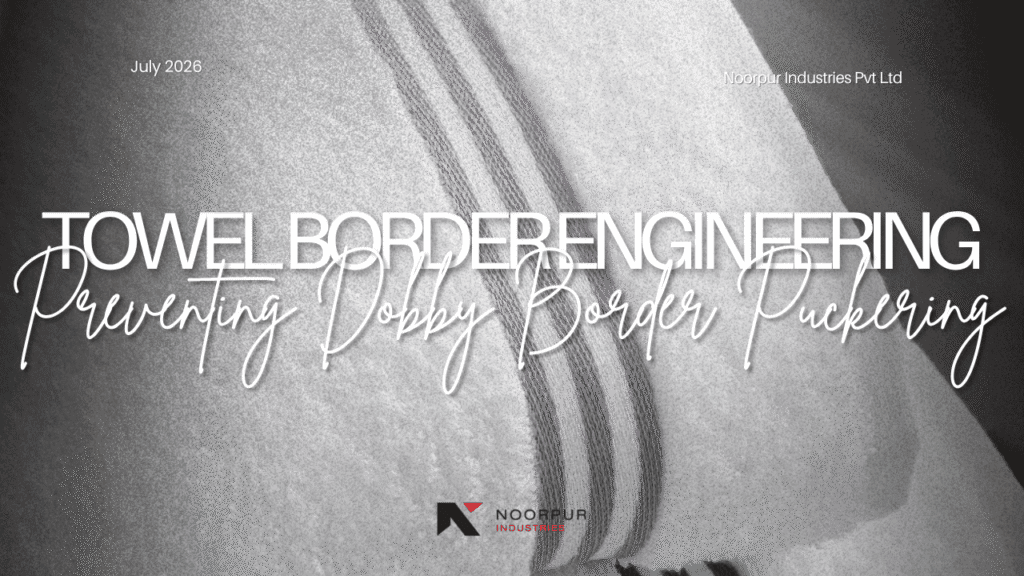
In executive hotel suites, luxury wellness spas, and commercial linen hire operations across Europe and Australia, presentation is everything. When a guest steps into a five-star bathroom in London, Munich, Sydney, or Paris, they expect immaculate, plush, perfectly rectangular bath towels that fold completely flat on heated towel rails.
However, commercial laundry directors and institutional procurement officers frequently encounter a frustrating engineering flaw: dobby border puckering.
Puckering occurs when the flat, decorative dobby band across the width of a towel contracts at a significantly higher rate than the surrounding terry loop body during high-temperature washing and tumble drying. The result is an unsightly “hourglass” distortion, wavy edges, and curling borders that make uniform stacking and mechanical folding impossible.
For institutional buyers, preventing dobby border puckering towels is not merely an aesthetic preference—it is a critical requirement to protect inventory investment, prevent premature discards, and ensure operational efficiency in On-Premise Laundries (OPL).
1. The Root Cause: Differential Shrinkage Physics
To solve dobby border puckering, we must examine the physical and mechanical forces at play on the weaving loom and inside commercial washing tunnels.
       [ Terry Pile Body ] ──► Dual-Warp Structure (Ground + Loose Loop Pile)
                                              │
       [ Mechanical Shift ] ──► Loom Transitions into Flat Dobby Band
                                              │
       [ Dobby Border ]    ──► High-Density Weft Interlacing (Zero Loops)
                                              │
       [ Thermal Washing ] ──► Differential Contraction Causes Border "Hourglass"
A terry towel is composed of two distinct structural zones:
- The Main Terry Body: Woven using two separate warp beams—a ground warp (which forms the structural base fabric) and a pile warp (which provides the extra yarn length fed forward to form raised absorbent loops).
- The Dobby Border Header: A dense, loopless band woven using a specialized dobby mechanism. Here, the pile threads are integrated flat into the ground weave, or the loom transitions into a tight plain, twill, or geometric dobby weave pattern.
Why Does Puckering Happen?
- Tension Discrepancy During Weaving: The pile warp yarns in the main body are woven under relatively low tension to allow loops to rise freely. Conversely, the dobby border requires tight, high-density weft insertion (picks per inch) under high warp tension to create clean geometric patterns.
- Yarn Twist & Density Imbalance: The dobby section packs significantly more weft threads per centimeter than the adjacent terry section. When exposed to 70°C+ thermal washing and high-velocity tumble drying, tight, high-twist weft yarns relax and contract far more than loose terry ground structures.
- Differential Hydro-Thermal Contraction: Cotton fibers naturally swell in water and shrink longitudinally as they dry. Because the dobby border has a denser yarn structure and different crimp interchange between warp and weft, it shrinks faster and tighter than the surrounding loop body. The borders pull the sides inward, causing severe puckering and edge curling.
2. Loom Engineering: How Precision Weaving Eliminates Puckering
At the manufacturing level, preventing dobby border puckering requires advanced loom control, precise yarn engineering, and strict tension balance during production.
                  ┌─────────────────────────────────────────┐
                  │    DOBBY BORDER ANTI-PUCKERING ENGINE   │
                  └────────────────────┬────────────────────┘
                                       │
        ┌──────────────────────────────┼──────────────────────────────┐
        ▼                              ▼                              ▼
┌───────────────┐              ┌───────────────┐              ┌───────────────┐
│ DUAL ELECTRONIC│              │ SANFORIZATION │              │ POLI-COTTON   │
│ WARP FEED     │              │ PRE-SHRINKING │              │ BORDER WARP   │
├───────────────┤              ├───────────────┤              ├───────────────┤
│ • Equalizes   │              │ • Mechanical  │              │ • Polyester   │
│   border vs   │              │   compaction  │              │   core locks  │
│   body tension│              │   prior to cut│              │   shrinkage   │
└───────────────┘              └───────────────┘              └───────────────┘
1. Dual-Beam Electronic Let-Off Systems
Modern high-speed air-jet looms equipped with electronic let-off (EFLO) and electronic take-up (EFTU) controls dynamically adjust warp tension in real-time. When the loom transitions from the terry body into the dobby header, the computer automatically recalibrates the warp tension, preventing excessive thread packing in the border.
2. Differential Yarn Count Selection
Using the exact same yarn count for both the terry body and the dobby border is a common cause of puckering. Engineering high-durability, non-puckering towels requires selecting specific yarn counts for the border:
- Pre-Shrunk Filament Core Yarns: Incorporating low-shrinkage polyester-core or mercerized cotton yarns into the dobby weft creates a dimensionally stable “skeleton” that resists heat compaction during laundering.
- Optimized Pick Density: Reducing the weft pick density slightly within the dobby section prevents the border from becoming overly dense compared to the ground weave.
3. Mercerized & Pre-Shrunk Border Yarns
Mercerization treats cotton yarn with a caustic soda solution under tension. This permanently swells the cellulose fibers, rounds out their cross-section, and removes residual shrinkage capacity before the yarn ever touches a loom. Dobby borders woven with mercerized yarns remain flat and dimensionally stable across hundreds of wash cycles.
3. Technical Benchmark: Standard vs. Anti-Puckering Dobby Specs
When preparing technical tender documents for hospitality or commercial linen supply, procurement managers should mandate the following engineering parameters:
| Technical Specification | Standard Commercial Towel | Anti-Puckering Engineered Towel |
| Loom Type | Basic Rapier Loom | Air-Jet Loom with Electronic Dual Let-Off |
| Dobby Weft Yarn | Standard Carded Single Yarn | Mercerized Combed / Low-Shrinkage Core Yarn |
| Warp Tension Control | Static / Manual Weight Beam | Dynamic Computer-Controlled Electronic Tension |
| Differential Shrinkage Limit | 8% – 12% (Causes severe puckering) | < 2.5% (Maintains flat, rectangular layout) |
| Finishing Process | Standard Stenter Drying | Continuous Mechanical Pre-Shrinking & Tumbling |
| Expected Wash Lifespan | 50 – 80 Commercial Cycles | 180 – 250+ Commercial Cycles (Zero Distortion) |
| Foldability & OPL Stacking | Wavy edges; requires hand ironing | 100% Flat; Compatible with Auto-Folders |
4. Operational & Financial Impact for Linen Managers
In commercial laundries across Europe and Australia, automated towel folding machines rely on uniform textile dimensions. When towels suffer from dobby border puckering, auto-folders jam or eject distorted towels into reject bins, forcing staff to hand-fold linens and driving up labor costs.
  500 GSM Bath Towel Portfolio Impact (15,000 Unit Commercial Fleet)
  ========================================================================
  [Standard Puckering Towels]  12% Discard Rate due to Border Distortion
  [Engineered Dobby Towels]    < 0.5% Discard Rate due to Border Distortion
  ------------------------------------------------------------------------
  Annual Cost Reduction: Prevents €18,000+ / AU$28,000 in premature discards.
  ========================================================================
Takeaway for Procurement: Specifying dimensionally stable dobby borders eliminates edge warping, optimizes automated laundry throughput, and drastically lowers total Cost-Per-Wash (CPW).
5. Manufacturing Excellence at Noorpur Industries Pvt Ltd
At Noorpur Industries Pvt Ltd, we bring over 50 years of manufacturing expertise to solving complex textile engineering challenges. Operating from our integrated manufacturing hub in Karachi, Pakistan, we produce high-performance institutional linens engineered specifically for the demanding hospitality and healthcare sectors of Europe and Australia.
       [ Combed Ring-Spun Cotton ] ──► Air-Jet Weaving with Electronic EFLO
                                                    │
       [ Mercerized Dobby Weft   ] ──► Dimensionally Stable Border Construction
                                                    │
       [ Continuous VAT Dyeing   ] ──► Chlorine-Safe & Colorfast Processing
                                                    │
       [ Automated Quality QA    ] ──► ISO 9001 & OEKO-TEX Standard 100 Certified
Our Anti-Puckering Dobby Engineering Guarantees:
- Precision Air-Jet Weaving: Our modern weaving floor uses computerized air-jet looms equipped with electronic dual-beam tension controls to balance warp and weft tension across every millimeter of the towel.
- Pre-Shrunk & Mercerized Border Accents: We incorporate high-tenacity, pre-shrunk, and mercerized yarns into our dobby headers, guaranteeing that border shrinkage matches main terry pile shrinkage perfectly (differential shrinkage under 2%).
- Stringent Wash Testing: Pre-production samples undergo rigorous 20-cycle high-temperature industrial laundry audits in our in-house QA laboratory, measuring dimensional stability under ISO 15797 and AS/NZS standards.
- Global Environmental & Social Certifications: Our manufacturing infrastructure holds ISO 9001, ISO 14001, OEKO-TEX Standard 100, BSCI, and GOTS certifications, providing complete supply chain compliance for European and Australian trade partners.
Frequently Asked Questions (FAQs)
What is dobby border puckering on towels?
Dobby border puckering occurs when the flat, woven decorative header near the ends of a towel shrinks at a faster rate than the surrounding looped terry pile body during washing and drying. This uneven shrinkage pulls the edges inward, creating a warped, wavy “hourglass” distortion along the borders.
Why do cheap hotel towels pucker after a few washes?
Cheap towels often pucker because manufacturers use standard, high-shrinkage carded yarns across both the body and border without adjusting weaving tension. On basic looms, warp tension in the border is pulled too tight, causing the dense weft threads to contract heavily once exposed to hot water and tumble drying.
Can puckered dobby borders be fixed after laundering?
Once a dobby border has puckered due to structural yarn shrinkage, it cannot be permanently reversed. While steam ironing or heavy pressing may temporarily flatten the fabric, the border will pull inward again as soon as it encounters humidity or subsequent washing. The defect must be prevented at the loom engineering stage.
How do I specify anti-puckering towels in an RFP/RFQ?
In your technical purchase specification, explicitly require: “Dobby border constructed with dynamic electronic warp tension control, mercerized or pre-shrunk border yarns, and maximum allowable differential shrinkage between body and border of less than 2.5% under ISO 15797 / AS/NZS testing standards.”