
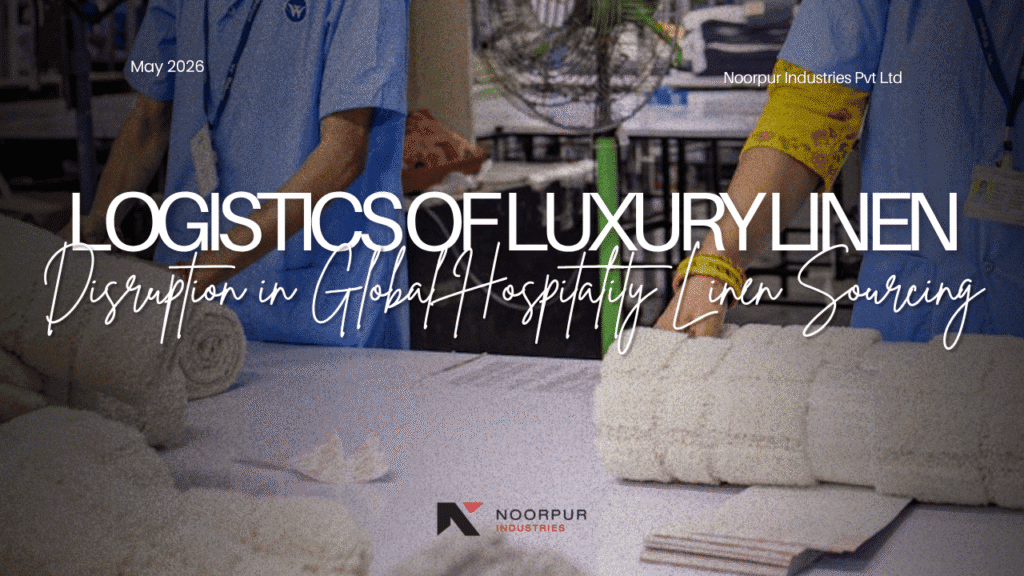
The international premium hospitality sector across Western Europe and Australia is confronting a hidden operational bottleneck. While corporate headquarters focus on guest acquisition and architectural updates, property operation managers face an unpredictable challenge: the breakdown of global textile supply chains.
From corporate hotels in Frankfurt and Paris to upscale boutique resorts along Australia’s eastern seaboard, relying on multi-tiered trading brokers, unverified textile agents, and fragmented shipping channels introduces significant business risks.
When a luxury hotel network or commercial healthcare facility relies on generic, unverified supply lines, it remains highly vulnerable to shipping delays, hidden import fees, and inconsistent fabric quality. A delivery block of bath towels or pool linens that arrives late, feels abrasive, or shrinks unevenly forces housekeepers to hold back room setups, directly impacting a property’s occupancy capacity and guest satisfaction ratings.
To protect operational budgets, secure absolute product consistency, and meet strict international sustainability requirements, leading hospitality purchase directors are shifting away from traditional broker networks. The global industry is moving toward a highly strategic solution: establishing direct, transparent partnerships with vertically integrated EU Green Deal textile suppliers capable of managing the entire production process from raw fiber selection to final doorstep delivery.
Technical Risk Management: Why Vertical Integration Eliminates Supply Chain Friction
For multi-property procurement directors managing hotel assets across the Eurozone and the Asia-Pacific region, textile purchasing is a critical risk-management exercise. Every intermediary step added to a manufacturing supply chain introduces another layer of hidden costs, unpredictable delays, and potential quality issues.
The Vulnerability of Tiered Broker Sourcing
In a traditional, multi-tiered sourcing model, a trading broker buys yarn from one spinning mill, commissions a third-party weaving house to produce the towels, and utilizes an unverified external facility for chemical finishing and dyeing. This fragmented production process lacks a unified quality control system.
When a hotel group receives a batch of towels featuring thin center cores, weak seams, or uneven edges that shrink incorrectly under commercial laundering, identifying the root cause is nearly impossible. This supply chain opacity introduces significant compliance risks for enterprise organizations.
The Security of Vertical Control
Direct sourcing from a vertically integrated textile manufacturer completely removes these operational blind spots. Every stage of production – from the raw long-staple cotton combing and ring-spinning phases to automated loom weaving, Indanthrene vat dyeing, and double-lock finished stitching – takes place within a single, unified corporate ecosystem under strict quality guidelines.
For international enterprise buyers, this comprehensive vertical control provides three vital operational protections:
- Absolute Batch-to-Batch Consistency: Every delivery block features identical thread counts, precise weight profiles, and matching color fastness, ensuring a reliable guest presentation across all properties.
- Direct Price Optimization: Eliminating intermediate trading agents and broker markups gives procurement networks access to honest factory-direct pricing, lowering upfront purchase costs.
- Transparent Supply Line Security: Operating a direct factory connection gives European and Australian buyers clear visibility into manufacturing timelines, accurate shipping schedules, and verified origin data, removing the guesswork from global freight logistics.
Engineering for Industrial Laundering: Material Physics of Combed Ring-Spun Cotton
The true financial performance of a commercial textile asset is determined inside high-speed industrial laundry facilities. In the intensive service environments of Europe and Australia, institutional bath linens are subjected to daily high-temperature washing, mechanical agitation, and heavy chemical sanitation. Retail-grade products or low-tier textiles woven from carded open-end yarns quickly fail under these harsh conditions.
The Short-Staple Structural Failure
Carded cotton yarns retain a massive volume of short, weak, and immature fiber fragments loosely spun within their core. Under the intense heat and friction of commercial laundering, these short fibers rapidly fracture and break free from the yarn structure.
For property operators, this material breakdown results in rapid fabric thinning, rough surface textures that irritate guest skin, and heavy lint buildup that chokes industrial dryer ventilation systems, driving up facility maintenance costs.
The Long-Staple Combed Blueprint
Premium institutional towels utilize 100% long-staple combed cotton as their structural foundation. During processing, the cotton undergoes a rigorous mechanical combing stage that completely pulls out the weak, short fiber fragments. Only the longest, most resilient cotton staples are permitted to proceed to the spinning frames.
These remaining long fibers are then processed using traditional ring-spinning methods, drawing out and continuously twisting the strands. This action locks the fiber ends deep within the core of the yarn, creating an incredibly uniform, smooth, and compact cylindrical thread. This engineered yarn features superior natural tensile strength, remarkable elasticity, and a highly smooth outer surface that easily withstands high-temperature sanitization without shedding its mass or losing its structural integrity.
Architectural Mass: Balancing Guest Experience with Energy Efficiency
A common misconception among corporate procurement teams is that an exceptionally heavy towel is always superior. While consumer retail marketing celebrates dense, 800 GSM bath sheets, these heavy products are a major liability for high-volume commercial laundries. An unengineered, excessively heavy towel traps water tightly within its dense core, requiring extended, high-heat drying cycles that stress the cotton fibers and drive up utility costs, undermining a property’s emission-reduction goals.
By engineering a targeted 600 to 650 GSM profile using a breathable double-loop weave, manufacturers provide an optimal balance. This weight delivers the thick, comforting, and premium hand-feel expected in luxury environments, but features an open core structure that allows hot air to circulate freely during tumble drying. This optimizes thermal efficiency, cuts down laundry cycle times, and lowers energy consumption across large-scale hotel groups.
Furthermore, this double-loop terry framework uses two distinct ring-spun yarns twisted together to form each upright loop, doubling the active surface area of the fabric. These vertical double-loops remain upright and springy through hundreds of wash cycles, creating an immediate capillary effect when touching wet skin to absorb moisture instantly without requiring heavy rubbing.
Regulatory Readiness: Meeting Europe and Australia’s Strict Environmental Mandates
As international trade regulations tighten, sustainability has evolved from a voluntary marketing narrative into a strict legal compliance framework. Enterprise buyers who source from unverified, non-compliant factories risk facing severe customs barriers, financial penalties, and significant brand damage.
Navigating the European Green Deal
In Europe, the Circular Economy Action Plan and the Strategy for Sustainable and Circular Textiles mandate that products entering European ports must be designed for long-term durability, repairability, and safe chemical recycling. The upcoming Digital Product Passport (DPP) will soon require an unalterable digital record for every batch of textiles, detailing raw material origin, carbon footprint tracking, and chemical processing logs.
Meeting Australian ESG Compliance
Simultaneously, the Australian hospitality market is experiencing its own regulatory shift. With tightening Commonwealth modern slavery regulations and rising investor demands for measurable Scope 3 emissions reductions, major resort networks are actively auditing their offshore manufacturing partners. Sourcing commercial textiles from vertically integrated suppliers who can verify their ecological footprint has become essential to passing stringent corporate compliance audits.
True sustainability must be woven directly into the manufacturing process. This requires partnering with producers utilizing closed-loop chemical systems and advanced Effluent Treatment Plants (ETP) that isolate, purify, and recycle processing water directly within the factory walls, preventing harmful chemical runoff from entering local ecosystems.
Furthermore, textiles must achieve the OEKO-TEX Standard 100 certification baseline. This international verification guarantees that every component of the linen – from the primary terry loops to the structural sewing threads and custom borders – is completely free from harmful levels of toxic substances, heavy metals, or volatile organic compounds (VOCs). In high-end hospitality environments where towels come into direct, prolonged contact with moisture-exposed skin, chemical purity is a non-negotiable health, safety, and brand metric.
Calculating Total Cost of Ownership (TCO) over Unit Price
For corporate financial officers managing international procurement across large hospitality networks, textile acquisition must be evaluated through a rigorous Total Cost of Ownership (TCO) calculator rather than checking initial checkout prices. A low-cost, lower-grade towel might look attractive on a quarterly purchase sheet, but its rapid degradation creates a continuous financial drain.
Low-grade carded towels typically show severe structural breakdown – such as thinning centers, loose threads, and frayed corners – after just 70 to 90 industrial wash cycles, requiring a complete pool replacement multiple times a year.
In contrast, an engineered institutional towel constructed from combed ring-spun cotton comfortably maintains its structural integrity and plush loft for 180 to 220+ high-velocity wash cycles. By more than doubling the active lifespan of the textile asset, a property cuts its annual replacement costs in half, allowing procurement teams to fully amortize their initial investment and unlock major capital savings.
By moving away from trading brokers to establish direct partnerships with vertically integrated manufacturing networks, enterprise buyers eliminate hidden intermediary markups. Direct-from-manufacturer sourcing gives European and Australian hotel groups direct access to factory pricing, custom weight profiles, and consistent production quality, providing complete transparency over the global supply chain.
Partner with Noorpur Industries Pvt Ltd
At Noorpur Industries Pvt Ltd, we combine over a decade of advanced textile engineering expertise with a deep commitment to high-performance manufacturing and international sustainability standards. Our vertically integrated production facilities specialize in crafting premium institutional linens and luxury beach textiles engineered explicitly to withstand the rigorous operational demands of the European and Australian hospitality, healthcare, and commercial distribution sectors.
Protect your property’s operational budget, eliminate supply chain intermediaries, and secure absolute consistency across your global supply chain by contacting our corporate procurement team today.
- Corporate Head Office & Manufacturing Facility: Plot No. 78, Sector 24, Korangi Industrial Area, Karachi-74900, Pakistan.
- Direct Corporate Line: +92 345 2596100 | +92 321 2714524
- Official Corporate Email: noorpur@noorpur.com.pk
- Web Infrastructure: www.noorpur.com.pk